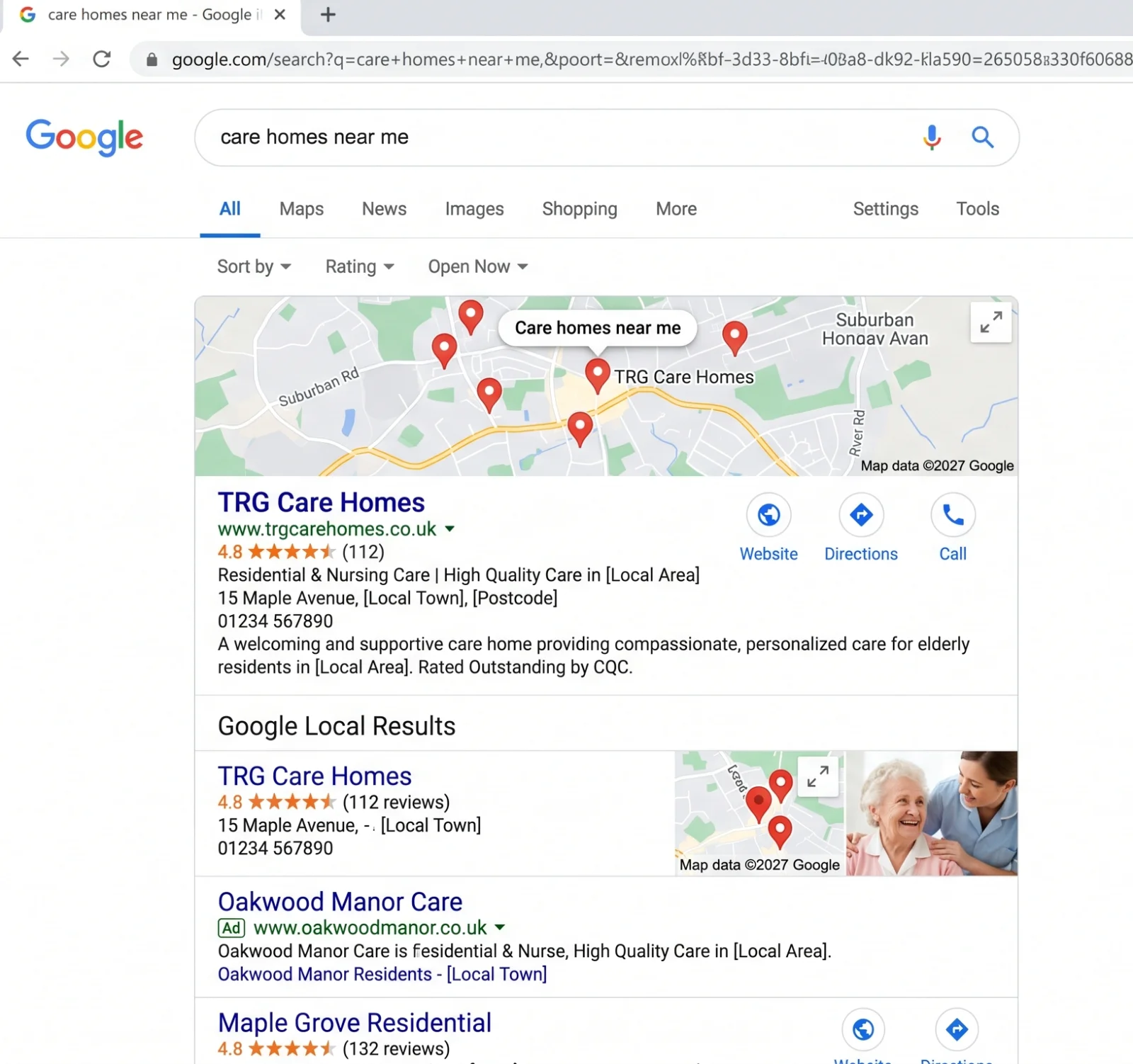
Families Are Asking ChatGPT for Care Home Recommendations. Are You in the Answer?

Written by Len Burgess, Founder
Len Burgess is the founder of TRG Digital, a specialist digital agency for the UK care sector. He has worked in SEO and digital marketing for over a decade and writes about search, ranking factors and lead generation through a data-first lens: read the data, apply best practice and logic, test, and repeat until you rank.
Connect on LinkedIn
A family is sitting in a hospital side room at 10pm, the discharge coordinator has just used the phrase "residential care" for the first time, and the family opens a laptop, pulls out a phone, and types a question into ChatGPT.
Not Google. ChatGPT (or Gemini or Claude). They ask for care homes near them that handle post-stroke recovery, that take local authority top-ups, that have availability now. They get an answer. They form a shortlist. Your home is either in that answer, or you have already lost that enquiry before you ever knew it existed.
This is not a future scenario. It is happening tonight, in your catchment, while you read this. The families who will fill your private-pay beds in 2026 and beyond are using AI assistants to research, shortlist, and decide based on these results which care home to approach for a visit.
Most care home operators have never checked what the answer says. This article will show you exactly how AI answers are built, where the data comes from, and what you can do this week to make sure your home is in the answer.
Because if you are not in the answer, you do not exist to that family, and that empty bed you have goes empty for longer, costing you money every month.
So keep reading and get all the details and then an explanation of how we at TRG Digital can help you get found in the AI Age.
How AI Answers Are Actually Built (And Why Your Home Is Not in Them)
Let us dismantle the central misconception immediately. The model does not know your home. It is not recalling you from training data, some vast memory of every care home it absorbed during development. When someone asks for care homes near Ipswich, the assistant runs a live search at that moment and writes a summary of what it retrieves. Everything follows from that single fact.
The model is a writer, not a memory. It composes answers from sources it can access at query time (when the consumer is asking for care homes), which means recency and indexability matter more than reputation.
A home that has been rated Outstanding for a decade but has no crawlable web presence is invisible (we wrote about getting found in our blog post title "Care Homes Near Me": What Actually Decides Who Google Shows First).
A home that updated its directory profile last week with current fees, reviews and importantly bed availability is quotable. Being quotable matters more than being persuasive. The assistant needs clean, factual, extractable statements it can synthesise into a recommendation. Marketing prose about "a warm, welcoming environment" is useless to it.
Different assistants use different retrieval pipes, and this matters practically. ChatGPT runs its own crawler and a search partnership to fetch live information.
Google's AI Overviews and AI Mode draw from Google's index and Business Profiles. Perplexity and Copilot use their own retrieval systems. These pipelines change frequently and are partly opaque. That uncertainty is uncomfortable, but ignoring it because the ground keeps shifting is commercially worse.
The direction of travel is unmistakable. OpenAI's June 2026 model update specifically targeted decision-making and recommendation queries, improving how location context and business details are combined. The systems are being built for exactly this use case, so having the right information on your website, like a live bed vacancy checker, is key to getting found and recommended at the right time.
The Three Layers of the AI Data Stack
When an AI assistant answers a care home query, it pulls from three layers of sources. Understanding this stack is the anatomy lesson that frames everything else you need to do.
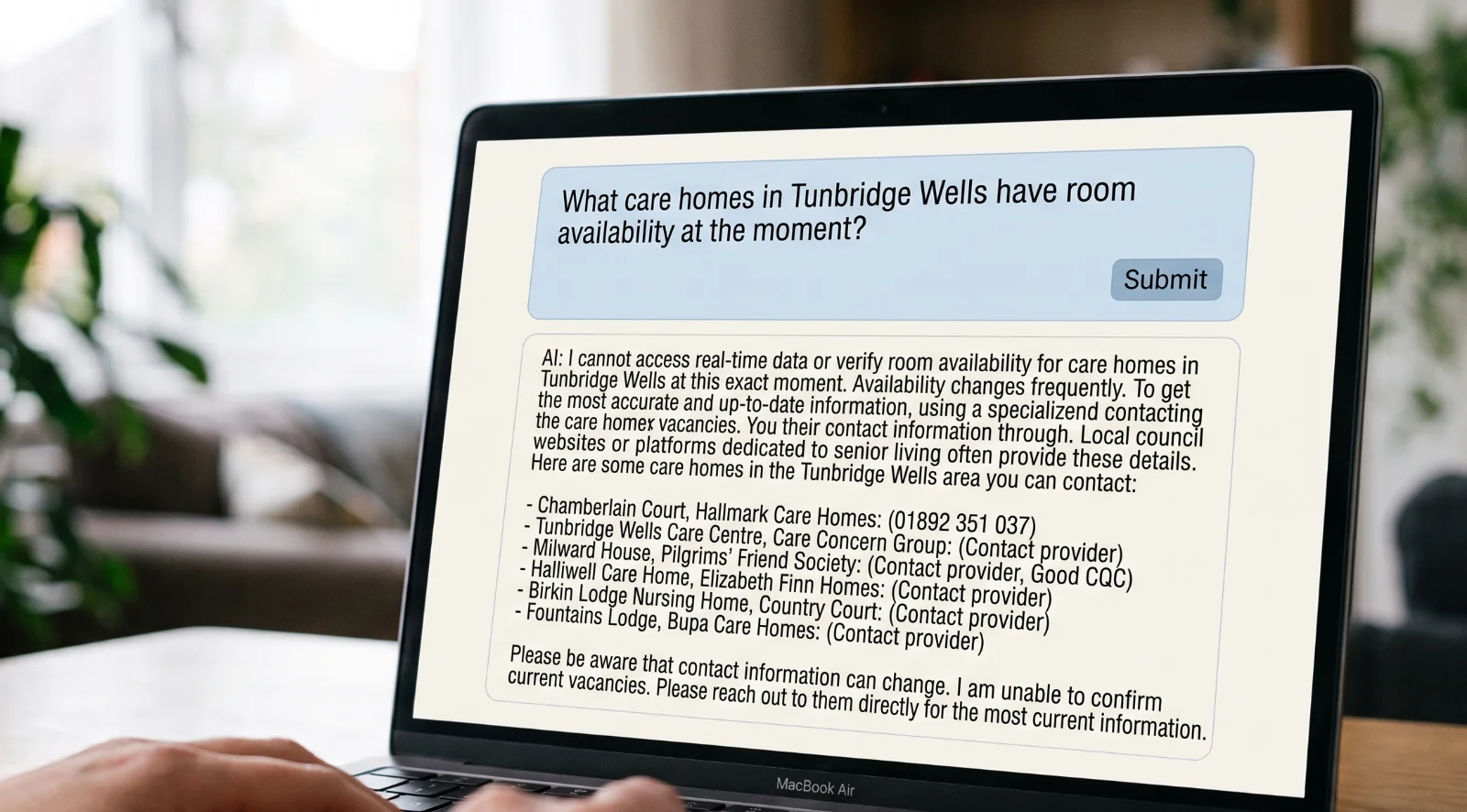
Layer One: The Regulator
The CQC in England is the foundation. Its data is structured, published, and heavily crawled by every major AI system, making it the single most authoritative source an assistant can cite. Your CQC record is the anchor, so if it is wrong, incomplete, or inconsistent with your other listings, every AI answer about your home inherits that confusion.
There is a gap here that almost every UK article on this topic misses. Care Inspectorate Wales, the Care Inspectorate in Scotland, and RQIA in Northern Ireland publish materially less machine-friendly data than the CQC.
Layer Two: Directories
Directories are structured, crawlable, frequently updated, and heavily indexed. The UK landscape is effectively carehome.co.uk, Autumna, Lottie, TrustedCare and HousingCare, CareAssura.com, with carehome.co.uk holding the dominant share of family traffic. These platforms give AI assistants what they crave: consistent fields, one page per home, machine-readable data, and active maintenance.
A listing alone will not fill beds. But a complete, consistent directory profile is no longer a marketing extra. It is a retrieval requirement. If your directory profiles are thin, out of date, or inconsistent with each other, you are handing the assistant incomplete evidence and hoping it still names you. It usually will not.
Layer Three: Your Own Site and Google Business Profile
This is usually the weakest link, and it is the only layer you fully control. If your website blocks AI crawlers, or your Google Business Profile is missing fees and photos, you have effectively disabled your own voice in the answer. The assistant cannot cite what it cannot retrieve.
This layer is where you can act fastest, which is why the rest of this article focuses here. You do not need a regulator to update a record or a directory to approve a change. You can fix your own site and profile today.
Why Directory Listings Matter More Now, Not Less
For a decade, the standard advice was that directories were a lead-generation tax, and the smart money went into your own site. That advice is now backwards. The reason is corroboration.
AI systems weigh agreement across independent sources. A claim that appears only on your own website is a marketing claim. The same claim appearing on your CQC record, or directory profile, your Google Business Profile, and your site is a fact. Low corroboration does not produce a lower ranking. It produces omission. The model resolves uncertainty by leaving you out entirely.
Then there is the review insight, which is the single most actionable thing in this article. Star ratings barely matter to a language model. Review text matters enormously, because the model synthesises themes from what people actually write.
Work with TRG
Struggling to fill your beds?
See how we turn local searches into pre-qualified enquiries, delivered straight to your home.
A 9.2 home with sixty reviews mentioning dementia care, the garden, the food, and the activities programme is retrievable for "somewhere with a garden that is good with dementia." A 9.8 home with four reviews saying "lovely staff" is retrievable for almost nothing. When you ask families for reviews, prompt for specifics. The condition. What mattered to them. What the home actually did. You are, in effect, writing your own retrieval index in your residents' families' words.
There is a practical problem specific to care that compounds all of this. Your legal entity, your trading name, and your CQC-registered location name are frequently three different strings. Add a former name after an acquisition, and the model cannot confidently resolve that these records describe one home. This is the NAP consistency problem in its care-sector form, and it is rampant.
The fees decision is uncomfortable but important. Publishing an indicative weekly range costs you some negotiating room and buys you inclusion in every budget-constrained query a family types. The middle path is a range with a clear explanation of what shifts it: nursing needs, room specification, local authority contribution. That gives the assistant something quotable without boxing you into a fixed price.
Structured Data and Schema in Plain English
Here is the simplest way to understand schema, but first, what is schema?
Schema.org vocabulary can be used with many different encodings, including RDFa, Microdata and JSON-LD. These vocabularies cover entities, relationships between entities and actions, and can easily be extended through a well-documented extension model. As of 2024, over 45 million web domains markup their web pages with over 450 billion Schema.org objects. Many applications from Google, Microsoft, Pinterest, Yandex and others already use these vocabularies to power rich, extensible experiences.
The above does sound complicated, so I do recommend reading SEM Rush explination of it.
Your website is a menu written in prose. Schema is the same menu with the dish, the price, and the allergens in labelled boxes. Both say the same thing. Only one can be read reliably by a machine in a hurry.
Now here is the finding that will make specialists take you seriously. There is no schema.org type for a care home. The vocabulary has Hospital, Dentist, Pharmacy, MedicalClinic, but nothing for residential or nursing care.
This is a real structural disadvantage the sector has never articulated. The established workaround is to use LocalBusiness or Organisation and extend it with an external ontology reference via the additionalType property, pointing at a Wikidata or Wikipedia URI for "nursing home." It is a patch, not a solution, but it is the best patch available.
The highest-value property on the page is sameAs. It is the glue that tells a machine "the thing on this page is the same thing as this CQC record, this directory profile, this Google Business Profile, this Companies House entry." Entity resolution in one property. If you add nothing else to your site's structured data, add sameAs links to every authoritative source that describes your home.
Address, geo coordinates, telephone, visiting hours, and area served are the basics. Do them consistently. Fees go via offers and priceSpecification, expressed as a range. Specialisms, dementia, nursing, residential, respite, palliative, young onset, go as explicit properties rather than buried in paragraph copy. Group operators need one properly marked-up page per home, linked to the group with parentOrganization. A single group entity with fifteen homes, as described in the body copy, is nearly unreadable to a retrieval system.
How to Test What AI Says About Your Home Today
This is a thirty-minute test a home manager can run without help. It is the section that gets shared.
Set up properly first.
This is the gotcha nobody mentions. Use a temporary chat with memory and personalisation off. If you are signed into an account that has discussed your own home fifty times, you are testing your history, not the world. The assistant is personalising to you, and you will see a flattering answer that no family ever sees.
Run three tiers of prompt.
The branded prompt: "Tell me about [Home Name] in [Town]." This is an accuracy test. Log every wrong fact; you will be surprised how many there are.
The category prompt: "Best care homes near [Town] for dementia." A presence test. Are you named at all?
The realistic prompt, the way an actual adult child types it: "My mum has vascular dementia and is being discharged from [hospital] next week. We can afford around £1,100 a week. What are our options within 20 minutes of [Town]?"
This is the one that matters, and the one that will surprise you most - are you being found? (Change the wording on the realistic prompt accordingly; dementia is something to change; maybe include you want an en-suite bathroom; you get the gist.
Run each across ChatGPT, Google AI Mode, Gemini, Perplexity, and Copilot. For each answer, record whether you are named, where in the list you appear, what sources are cited, which facts are wrong, and which competitors appear.
Then do the useful diagnostic. Look at what the named competitors have that you do not. It is usually fees published clearly, review volume with specific detail, or a complete directory profile.
Now the server-side check, which turns opinion into evidence. Search your access logs for OAI-SearchBot, PerplexityBot, ClaudeBot, GPTBot, and Bingbot. If none appear, nothing else in this article will work until that is fixed.
A measurement caveat, stated honestly. Referral traffic from AI tools massively understates their influence, because most AI-influenced visits arrive as direct traffic or a branded search days later.
The family asks the assistant, gets your name, and then Googles you separately (so you still need to have a good website and online presence). Track branded search volume in Search Console as the better proxy, and add "how did you hear about us?" to enquiry forms with an AI option.
And to manage your expectations. There is no complaints department. When an assistant states something wrong about your home, you cannot correct the model. You correct the sources. CQC record first, then directory profiles, then your own site. Then you wait for recrawl. Test quarterly, and immediately after an inspection, a change of manager, or a change of ownership.
The Buried Landmine: Are You Blocking AI Crawlers Without Knowing It?
This is the section that will surprise most readers, and the one that makes the article worth keeping so you can refer to it time and time again.
Many care home websites block AI crawlers. GPTBot, OAI-SearchBot, PerplexityBot, ClaudeBot, and Google-Extended are frequently disallowed in robots.txt.
This is often added by a web agency reacting to "AI is scraping our content" panic. Sometimes it is a security plugin's default setting. Either way, the result is the same. Your home is invisible to the systems families are using to find care.
The critical distinction is between training crawlers and retrieval crawlers. Blocking training crawlers protects your content from being used to train models. Blocking retrieval crawlers removes you from answers. The latter is commercial self-sabotage. You are telling the assistant, at the server level, "do not look at my site." The assistant complies.
The instruction is simple and immediate. Open yourhome.co.uk/robots.txt right now. Look for these user-agent names (GPTBot, OAI-SearchBot, PerplexityBot, ClaudeBot). If you see them disallowed, you have found your problem. This is the one fix in the entire article that costs nothing, takes five minutes, and can change whether you appear in answers tomorrow.
Work with TRG
Want more private enquiries?
We put your home in front of the families actively searching for care near you.
The Work Is Simple. Doing It Consistently Is Not.
Read back through this article, and you will notice something. Almost nothing in it is difficult. Check a robots.txt file. Fix a directory profile. Add a sameAs property. Ask families for more specific reviews. Publish a fee range. Run five prompts in a temporary chat window.
None of it requires a technical degree. What it requires is someone who owns it and someone who manages the process.
And that is exactly where it falls down in most homes. Your CQC record sits with compliance. Your directory profiles sit with whoever set them up three years ago, possibly a manager who has since left. Your website sits with an agency that also builds sites for dentists and gyms. Your reviews sit with nobody. Your robots.txt sits with a developer you last spoke to in 2022.
Nobody owns the answer. So the answer gets written without you in it.
How TRG Digital Gets Your Home Into the Answer
We are a specialist digital agency for the UK care sector, and care is the only sector we work in. That matters here more than it usually does, because everything in this article is care-specific: CQC data, four different regulators, care-sector directories, funding language, and the way families actually search when they are frightened and short of time.
A generalist agency will optimise your site beautifully and never think about your CQC location name.
Here is how we work through the stack in this article.
Start with the free grade. Our care website grader runs 38 checks on your site in under a minute. It tells you whether you are mobile-friendly and fast, whether you display your CQC rating, whether you mention room availability, and where the gaps are. It costs nothing, and there is no obligation. If you do one thing after reading this, do that.
Layer three, the layer you control. We design and build fast, mobile-first care websites that render properly for crawlers, load quickly, and answer the questions families actually type. That includes the technical groundwork this article describes: crawler access, clean structured data, entity markup that ties your site to your CQC record and your directory profiles, and fees and care types published as readable HTML rather than buried in a downloadable brochure.
The quotable facts that get you named. Our care tools put live room availability, funding calculators for all four UK nations, NHS Continuing Healthcare and FNC checkers, and a dementia signs self-check directly on your site. Live availability is the single most quotable fact a care home can publish. When a family asks an assistant for homes with a bed available now, a home that publishes current availability is answerable, and a home that does not is a phone call the family has to make. Most will not make it.
Layer two, corroboration. Our Local SEO work covers citations and consistency across the places that describe your home, so your legal name, trading name and CQC-registered location name stop contradicting each other. We fully manage your Google Business Profile and reviews, keeping the listing accurate and active, growing genuine reviews and responding to every one. And we built our own UK care directory, CareAssura, which gives families a clear, structured comparison and gives your home another independent, well-indexed source saying the same true things about you.
Ongoing visibility, not a one-off fix. SEO and content creation build the answer-shaped pages that get retrieved and cited: care types, funding, local guides, the questions families ask at 10pm in a hospital side room. This is not a project you finish. Data goes stale, inspections happen, managers change, and the pipelines shift. We retest and maintain.
And catching the enquiry when it arrives. Remember the measurement caveat. Families who find you through an AI assistant usually arrive later as a direct visit or a branded search, often outside office hours. Our enquiry stack handles that moment: an AI chat assistant that answers instantly, click-to-call, missed-call text-back, call tracking and a CRM so no enquiry goes cold. Being in the answer is worth nothing if the enquiry it generates rings out at 8pm on a Sunday.
The Cost of Doing Nothing
One empty bed at £1,500 a week costs you £5,850 over three months and £11,700 over six. That is a single room. Meanwhile, the families who would have filled it are being handed a shortlist of three homes down the road, tonight, by a system that has never heard of you.
You do not need to become an expert in retrieval pipelines and structured data. You need someone who already is, and who understands care.
Get your free website grade and see exactly where you stand. Or book a free, no-obligation demo, and we will run the AI prompts on your home, in your catchment, and show you the answer families are seeing right now.
Call 020 8064 1596 or email hello@trgdigital.co.uk, or click on the button below and answer some really simple questions. We reply within one business day.