12 Local Pages Every Care Home Website Is Missing (And Why One Contact Page Isn't Enough)

Written by Len Burgess, Founder
Len Burgess is the founder of TRG Digital, a specialist digital agency for the UK care sector. He has worked in SEO and digital marketing for over a decade and writes about search, ranking factors and lead generation through a data-first lens: read the data, apply best practice and logic, test, and repeat until you rank.
Connect on LinkedIn
Most care home websites we audit have a single Contact page with an address, a postcode, and a phone number. The assumption is that Google knows where the home is, so families in the surrounding towns will find it. That assumption costs you private pay enquiries every week.
The fix is not more advertising spend or a prettier homepage. The fix is a set of care home local landing pages, built around the towns families actually search from and the care types you actually deliver.
Here is why one page is not enough, and how to build the twelve that are missing.
Remember, these are ideas and one of many ways TRG Digital can help you increase the number of new private enquiries.
The Problem: You Publish by Address, Families Search by Town
A single Contact page with a postcode is a listing, not a local presence. It tells Google you exist at a fixed point on a map, but it does not tell the search engine which towns you serve.
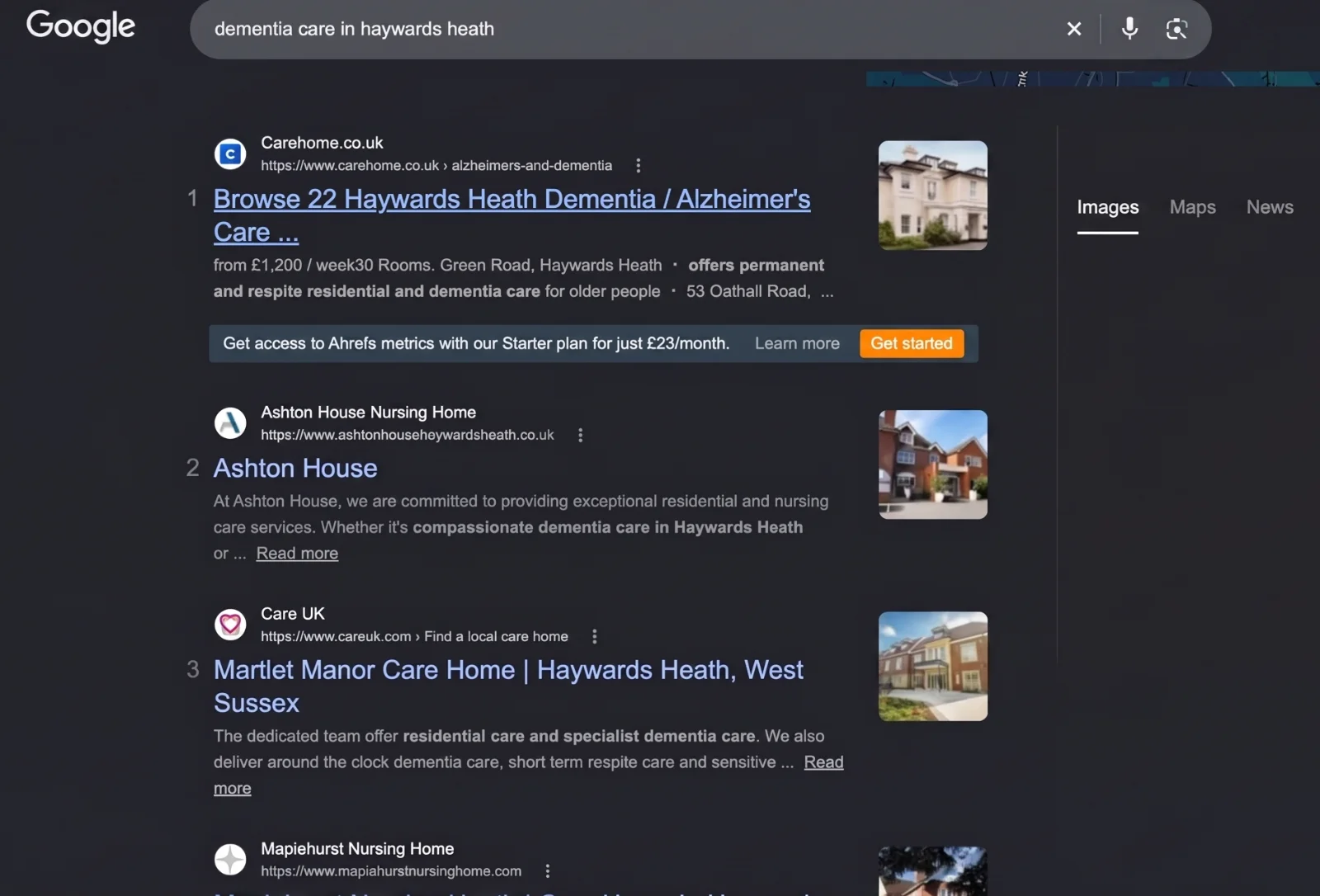
When a family types "dementia care Burgess Hill" into their phone at 9pm from a hospital ward, Google has to decide which pages are relevant to that specific query. A generic Contact page for a home in Haywards Heath will rarely win that decision.
The mismatch is structural. You organise your website around your business: Services, About Us, Contact, CQC Report. That makes sense internally, and you should do this.
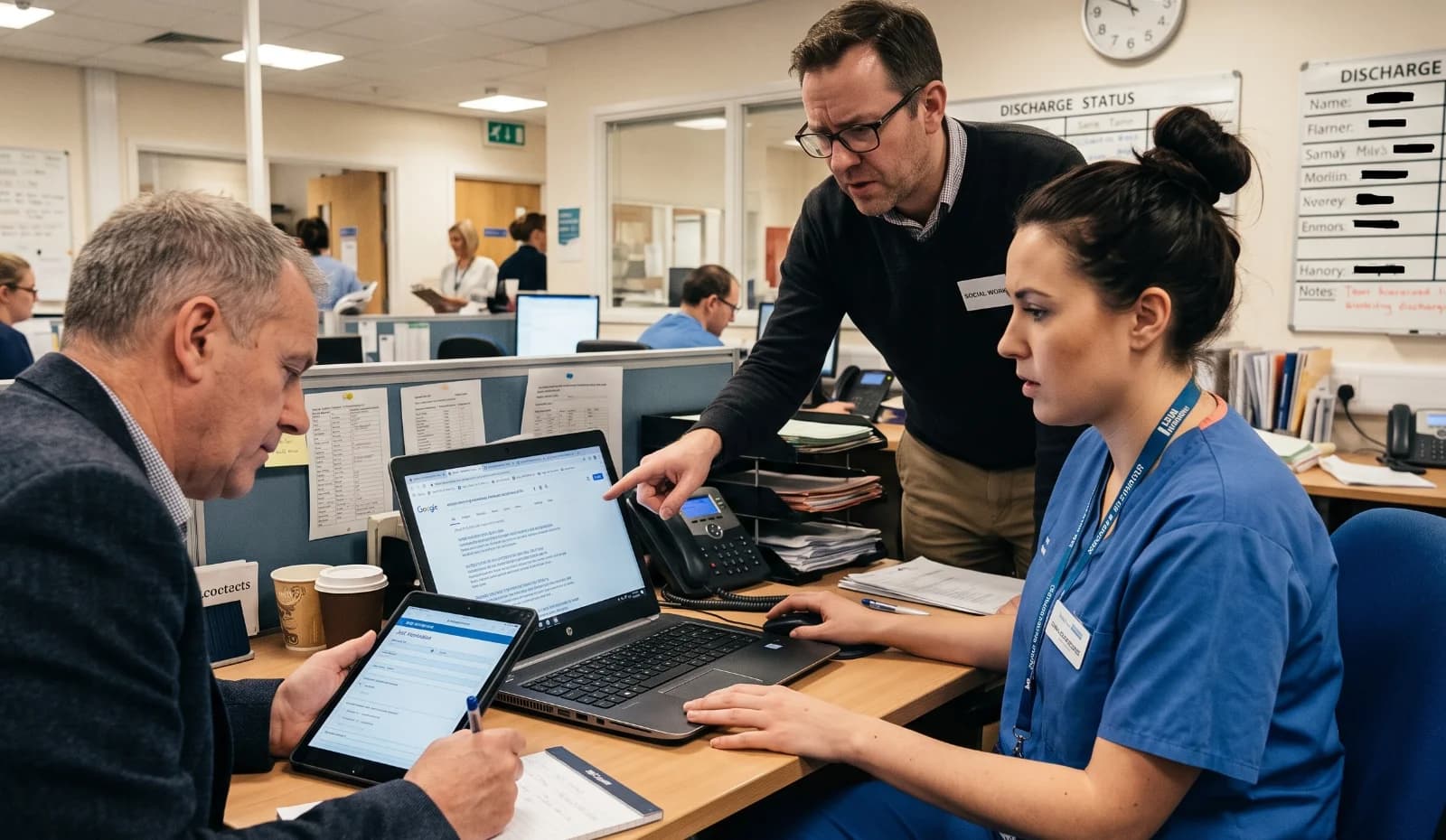
But families organise their search around geography and their loved one's condition. They are not browsing; they are filtering, fast, under pressure, often from a hospital corridor or a worried sibling's kitchen. They need to know, within seconds, whether your home is close enough to visit daily and whether you provide the right care and if you have a free bed (really important and often overlooked)
One page cannot rank for multiple town and care type combinations. Google treats a single page as relevant to one primary location, not a ten-mile catchment. If your Contact page mentions Haywards Heath, it is not going to appear for searches in Burgess Hill, Lewes, or Brighton, even if those towns are a fifteen-minute drive away.
The result is predictable: a competitor a postcode away wins the call because their website answered the specific question the family asked. Not because their care is better. Because they showed up.
The Fix: A Town × Care Type Matrix
The solution is not more content for the sake of it. It is the right content architecture.
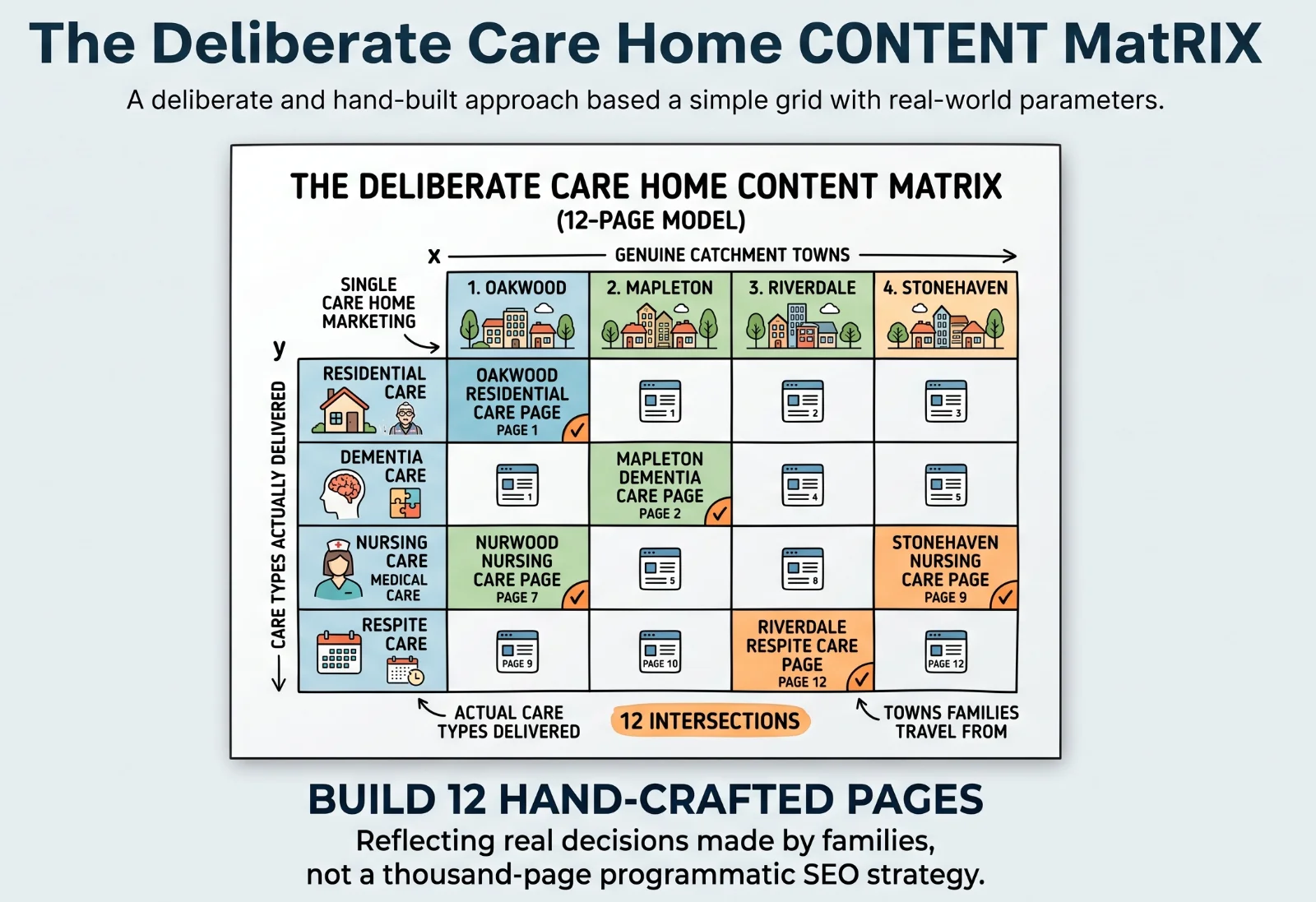
Think of it as a simple grid. On one axis, the towns you genuinely serve. On the other, the care types you actually deliver. Where they intersect, you build a page.
For a single care home, this usually means three or four care types crossed with three or four genuine catchment towns. Residential, dementia, nursing, and respite care, mapped against the towns where families actually travel from. That is your twelve-page matrix. It is not a thousand-page programmatic play designed to game a search engine. It is a deliberate, hand-built set of pages that mirror the real-world decisions families make when choosing care.
Each page targets a specific combination: "Dementia Care in Haywards Heath" or "Residential Care Homes in Burgess Hill." These are the long-tail searches with intent behind them. Someone searching that phrase is not casually browsing.
They are actively looking for a home, right now, in that town, for that type of care. The matrix also forces honesty; if you do not provide nursing care, you do not build a nursing page for any town. The architecture reflects what you actually do, not what you wish you offered.
Idea One: Catchment Is Drive-Time, Not Radius
A compass radius drawn on a map is a lazy shortcut. It includes towns that are geographically close but practically unreachable, and it excludes towns that are a fast, straight drive away.
A town three miles away through congested high streets and single-track lanes might take twenty-five minutes. A town six miles away down a dual carriageway might take twelve. Only one of those towns is in your true catchment.
Work with TRG
Struggling to fill your beds?
See how we turn local searches into pre-qualified enquiries, delivered straight to your home.
The only metric that matters is the journey a family will make to visit. Daily visiting is the reality for spouses and adult children during the settling-in period and beyond. A fifteen-minute drive down the A23 beats a ten-minute crawl through a town centre every time.
If you have enquiry data, use it. Map where your current residents' families actually travel from. That is your true catchment, not a circle on a screen; this is something we do for all our TRG clients.
Be specific in the page copy. "Twenty minutes from the A23" or "a fifteen-minute drive from Haywards Heath station" is real, useful information for a family weighing daily visits against work and childcare. This approach also protects you from wasting effort on towns where you will never convert because the drive time is a genuine barrier, no matter how close they look on a map.
Idea Two: Thin Duplication Is the Failure Mode
The reason most local pages fail is not that they do not exist. It is that they are 400 words of the same copy with the town name swapped. Google treats this as doorway pages and can drop them from the index entirely. Families will sense it too.
A page that says "Our care home provides excellent care in [Town Name]" twelve times is worse than having no local pages at all.
The question everyone asks is: what could you possibly write twelve times that is genuinely different? The answer is plenty, if you know the care business. Each town sits under a different local authority with different funding thresholds, different social services contact points, and different discharge pathways from local hospitals.
You will have residents and staff from those communities. Local landmarks, churches, clubs, and memories shape activities and reminiscence work. A resident from Lewes will have different reference points than a resident from Brighton. Mentioning the specific church they attended, the high street they shopped on, or the park they walked in is not filler. It is the kind of detail that tells a family you understand their world. And it is precisely the kind of content that cannot be spun out by an AI in thirty seconds, which is exactly why it works.
The 12 Pages, Mapped Out
Let us make this concrete. Take a fictional care home in West Sussex, located near Haywards Heath, providing residential, dementia, nursing, and respite care. The genuine catchment towns, based on drive time and where current families travel from, are Burgess Hill, Haywards Heath, Lewes, and Brighton. The matrix gives us twelve pages.
The H1 on each page should be the exact phrase a family types. Not "Our Services" or "Care We Provide." The page targeting families searching for dementia care in Burgess Hill should have the H1 "Dementia Care in Burgess Hill." The URL should follow the same logic: /dementia-care-burgess-hill/. This is not about keyword stuffing. It is about matching the search query with a page that answers it directly.
Each page needs a distinct opening paragraph that names the town, the journey time, and the specific care type. No generic openers about "providing quality care in a warm environment."
Start with the specific: "Our dementia care community is a twenty-minute drive from central Burgess Hill, straight down the A23, and we currently support residents from several families in the town."
The page must then answer the questions families from that town actually ask: what are the local authority funding rules in West Sussex versus Brighton and Hove, what is the discharge pathway from the Royal Sussex County Hospital or the Princess Royal, and how does your home connect to that specific community.
These are genuine questions that families searching for care will want answered.
What to Write on Each Page (Without Repeating Yourself)
Start with the journey. Describe the route from that town to your front door honestly and specifically. Mention the road, the landmarks, and the typical drive time. A family sitting in Burgess Hill weighing up three homes needs to know they can be at your door in twenty minutes without sitting in traffic, and let them know if you have on-site parking, a key fact that most people overlook.
Cover the local authority angle. Which council covers that town, what are their current funding thresholds, and how do you handle the fee mix between private and local authority placements. The good news is we have a local authority widget available to all our clients; it's a great way to provide accurate information and a pathway page.
A family from Brighton and Hove faces a different funding landscape than a family from West Sussex. Acknowledging that on the page tells them you understand the system they are navigating.
Name the local hospital and the discharge pathway. Families searching from a ward need to know you understand the step-down process, the assessments required, and the timelines involved. This is not clinical detail. It is practical reassurance.
Weave in community proof. Mention residents or staff who come from that town, and the local clubs, churches, or shops that residents still feel connected to. If you run reminiscence sessions that draw on local history, say so. If a staff member grew up in Lewes and knows the area intimately, that matters.
Close with a specific call to action for that town. Not a generic "Contact us today." Something like "Book a tour from Burgess Hill" or "Call us to talk about a move from Lewes." The specificity signals that you are speaking directly to them.
The Tools That Make This Work (And the Ones That Don't)
A website built on a platform that allows proper page architecture and fast loading is non-negotiable. A slow, templated site will kill the effort before it starts. If your current website makes adding twelve properly structured pages difficult, that is the first problem to solve.
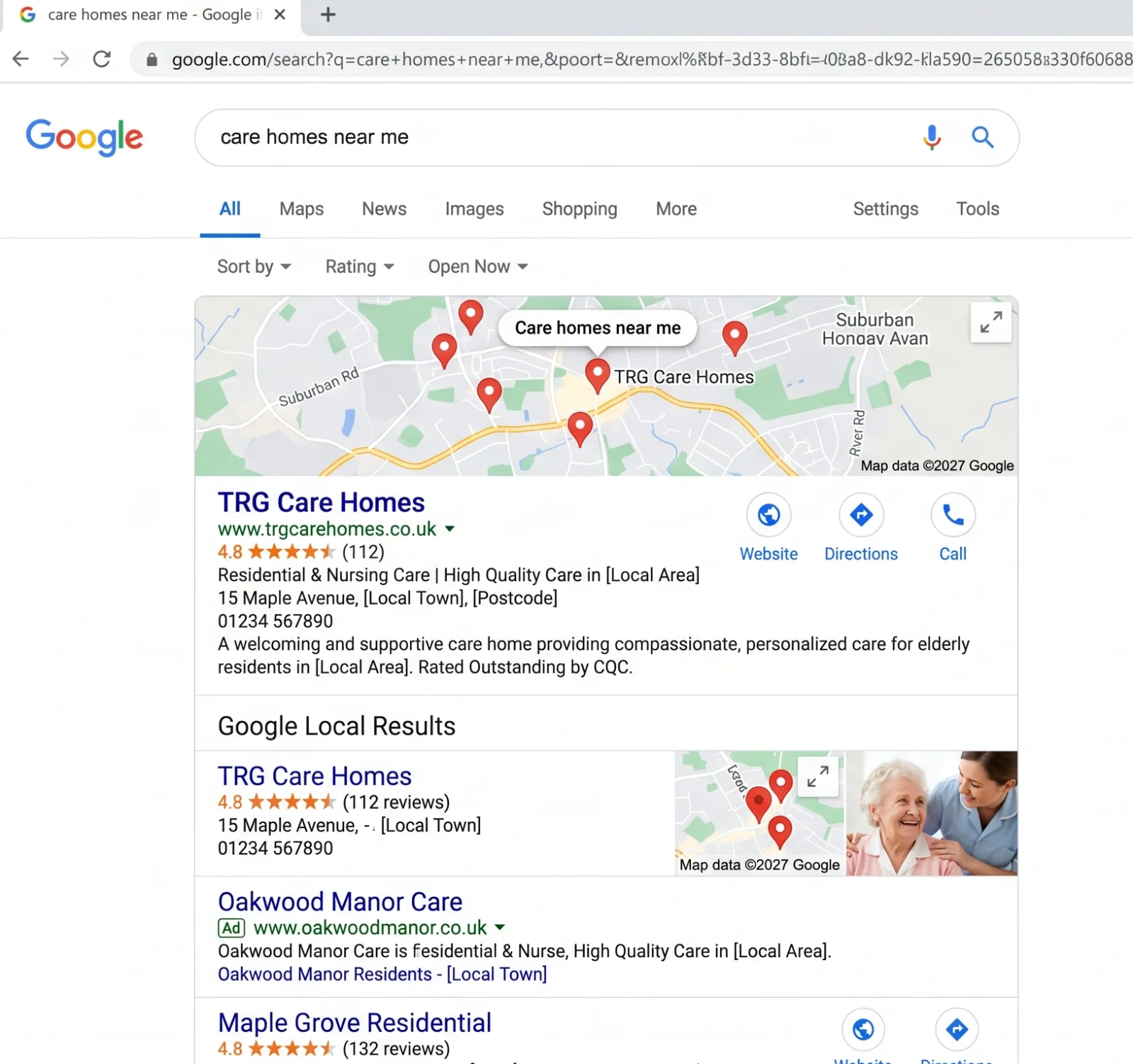
Google Business Profile is part of the picture, but it is not a substitute for these pages. The profile gets you into the map pack. The local landing pages get you the click when a family is comparing options. A listing alone will not fill beds.
Work with TRG
Want more private enquiries?
We put your home in front of the families actively searching for care near you.
Embedding a funding calculator or an NHS funding checker on these pages is a genuine service to a family in distress, not a gimmick. It answers the question many are too afraid to ask: can we afford this. You can see how this works on the care home funding calculator we built for exactly this purpose.
AI search is now a factor. Google AI Overviews and tools like ChatGPT pull from clear, structured, genuinely local content. Thin doorway pages with swapped town names will not get cited. Pages that contain specific, unfakeable local detail will.
What does not work: buying clicks with no follow-up process, relying on a directory listing alone, or handing the project to a generic agency that swaps town names in a template. That is how you waste a budget and end up back at square one, still wondering why the phone is not ringing.
How to Know It's Working
Measure enquiries, not clicks. The question is not how many people visited the page. It is how many families from Burgess Hill called or booked a tour. Track the source of new residents. Are families mentioning the town page when they make contact? That is the only proof that matters.
Look at the fee mix over time. If private pay enquiries from your genuine catchment towns increase, the pages are doing their job. If you are still filling beds primarily through local authority placements at fees below cost, something in the architecture or the content is not connecting.
Before you start building, run your current website through the free website grader to see where your existing pages fall short. Be patient but not passive. Local pages take a few months to earn trust with search engines, but if there is no movement in enquiries after a quarter, the content is not local enough, or the drive-time logic needs revisiting.
Start With the Towns You Know
Do not try to build all twelve pages in a weekend. Start with the two or three towns where you already have residents or where the drive time is strongest. Write the first page properly, with real local detail, and see how it performs before scaling the approach.
If you need a hand, we build care home websites, local SEO, and content under one roof, designed around how families actually choose care. Everything from local SEO for care homes to the page architecture and the words on the page is built by people who understand occupancy, fee mix, and the pressure of an empty bed.
The next step is simple. Pick one town, write one page, and answer the questions families in that town are actually asking. Book a free demo, and we will show you how it fits together.
Why TRG Digital
Twelve pages sounds simple until you sit down to write the second one. That is where most of these projects stall: the drive-time logic is guesswork, the local authority detail is wrong, and by page four the copy has quietly collapsed into the same paragraph with a different town name. The idea is easy. The execution is what separates a set of pages that fills beds from a set that Google ignores.
We only work in care. Not care plus dentists plus estate agents, residential and nursing homes, dementia care, home care, supported living and retirement living, and nothing else. That means we already know the difference between the West Sussex funding threshold and the Brighton and Hove one, what a step-down discharge from the Princess Royal actually involves, and why a family from a hospital ward at 9pm needs to see availability before they see your awards. You should not have to explain your own sector to your agency.
It also means the work is built rather than talked about. For Crossways Care Home and Ferndale Nursing Home, we built 67 local landing pages across the two homes, alongside 19 family tools and live room availability that their managers update in one tap. Both sites are live now and documented step by step in the case studies, so you can judge the approach on real homes rather than a pitch deck.
The tools mentioned throughout this article are ours, and they come with the work. Funding calculators for all four UK nations, NHS Continuing Healthcare and Funded Nursing Care checkers, the local council guide that answers the funding question on the town page itself, a dementia signs self-check, and AI chat that captures enquiries at 11pm when nobody is at the desk. Families are already searching for these answers. Better they find them on your site than on a directory that sells your enquiry to three competitors.
And we are measured the way you are. Not impressions, not rankings for their own sake, enquiries, tours booked, beds filled, and a fee mix that moves in the right direction. At around £225 a week between a private fee and an average council placement, one extra private resident pays for the work several times over.
Start where the risk is lowest. Run your site through the free website grader and see what a family sees. Then book a free demo, and we will map your genuine catchment, show you the twelve pages you are missing, and tell you honestly which two to build first.
Part of our guide to being found locally.