
"Care Homes Near Me": What Actually Decides Who Google Shows First

Written by Len Burgess, Founder
Len Burgess is the founder of TRG Digital, a specialist digital agency for the UK care sector. He has worked in SEO and digital marketing for over a decade and writes about search, ranking factors and lead generation through a data-first lens: read the data, apply best practice and logic, test, and repeat until you rank.
Connect on LinkedIn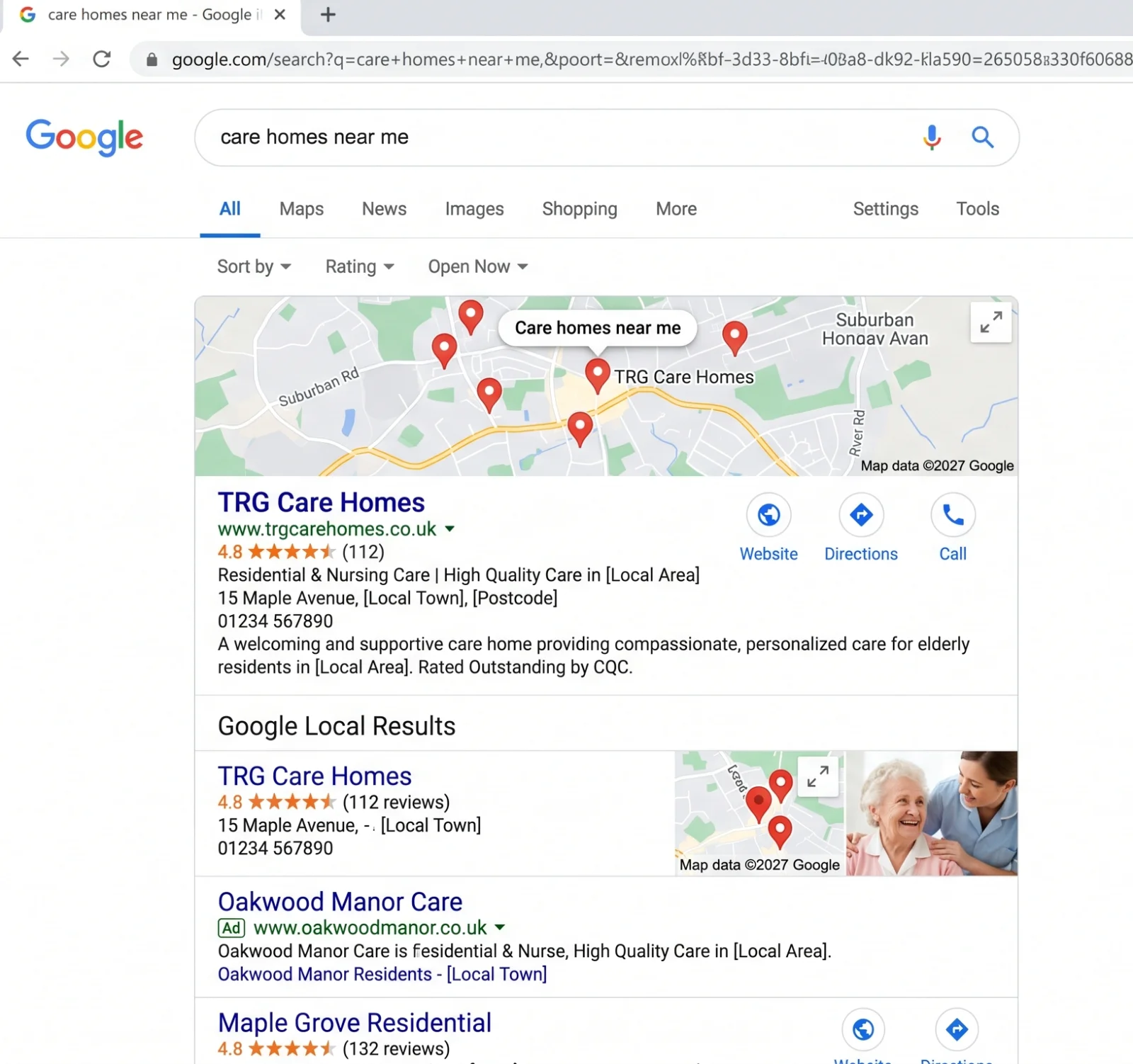
Most care home owners we speak to have a quiet suspicion about Google. They watch a home down the road, one with the same CQC rating and half the reputation, appear above them every time a family searches "care homes near me". It feels personal. It feels like the algorithm is getting it wrong.
It isn't personal. And the algorithm isn't getting it wrong. It's just working from evidence you haven't given it yet.
Here's the reframe that changes everything: Google is not a judge of the quality of care; it has never walked your corridors, spoken to your residents, or read your inspection report. It is a matching engine. When a daughter types "nursing homes near me" from a hospital ward at 9pm, Google isn't asking which home is best. It's asking which home it can most confidently match with this person in this place right now.
An Outstanding-rated home with a thin Google Business Profile and no reviews is, to Google, a less confident match than a Good-rated home two streets away that has answered every question a family might ask.
That isn't Google being unfair. It's Google having nothing to go on.
This article breaks down the three factors Google uses to decide who appears first, which ones you can change, and why the map pack and the blue links below it are two completely different games.
So keep reading, and remember if you want more details on this or want to discuss this further, drop us an email and we can book in a call.
Google Doesn't Rank Quality. It Ranks Evidence of Quality
Google has never inspected a care home. It cannot know your CQC rating, your staff retention, or the warmth of your lounge on a Tuesday afternoon. All it has is what's published about you online. Reviews, website pages, directory listings, news mentions. That's the raw material. Nothing else exists.
The three factors Google uses are proximity, relevance and prominence. They're the same three it uses for every local search, from plumbers to restaurants to elderly homes near me. The mechanism doesn't change just because the decision matters more.
The mistake most homes make is treating Google like a directory that should reward good care. It's not; there are plenty of directories out there that do this (we have our own one called CareAssura.com). It's a machine that rewards clear, consistent, well-supported information. If your dementia wing is wonderful but you've never published a page about it, Google has no way of knowing it exists. If your end-of-life care is exceptional but nobody has written a review mentioning it, that excellence is invisible.
The good news is that two of the three factors are entirely within your control. The third can be worked around. And the home down the road with the same rating and half your quality keeps appearing above you for one simple reason: they've given Google more to work with.
Proximity: The Factor You Can't Change (But Can Outsmart)
Proximity is exactly what it sounds like. Google shows homes near the searcher. The closer you are to the person holding the phone, the more confident Google is that you're a relevant match. It's the most straightforward of the three factors, and the only one you genuinely cannot alter. You cannot move your building.
Work with TRG
Struggling to fill your beds?
See how we turn local searches into pre-qualified enquiries, delivered straight to your home.
But here's the insight most managers miss. "Near me" isn't one fixed set of results. It's redrawn for every single search, based on where the searcher's phone is at that exact moment. Your catchment isn't a circle on a map. It's a constantly shifting shape that depends entirely on who is searching and where they're standing.
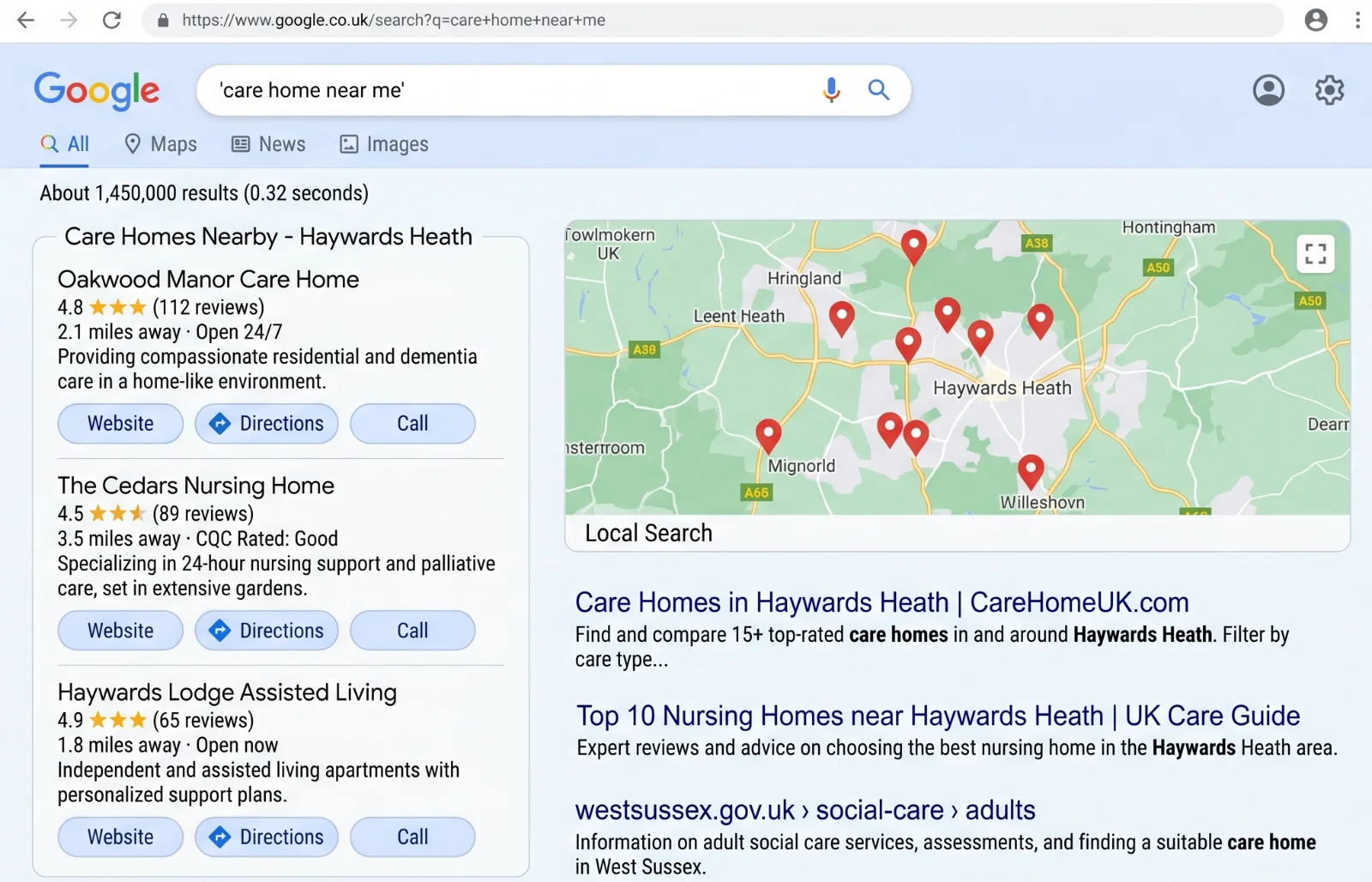
In care, this gets more interesting. The searcher usually isn't the resident. It's the daughter in Croydon looking for a home in Hastings. It's the son in Manchester researching dementia care in Cheltenham for his mother. These people are 60, 100, 200 miles away from the home they'll eventually choose. Proximity barely applies to their search at all.
This is the whole game. The families researching from a distance never see a proximity-weighted result. They see organic results and directory listings, where distance doesn't apply. So proximity isn't a verdict on your home. It's just the ground you're playing on. And you can change the game you're playing.
Relevance: Where Most Homes Quietly Lose
Relevance is Google asking a simple question: does this home actually offer what the searcher needs? And the brutal truth is, Google can only read what you've published. It cannot infer, it cannot assume, and it cannot give you credit for services you offer but never mention; how would it know?
This is where most homes quietly lose. The dementia wing that's described beautifully in the printed brochure but nowhere on the website. The nursing care that isn't ticked in your Google Business Profile categories. The respite beds that have been available for three years but nobody has ever written a page about. The end-of-life care your team delivers brilliantly, which appears on your site as half a sentence buried in a paragraph about something else.
Google cannot guess. If it can't read that you do it, you don't rank for it. A family searching "best nursing homes near me" will never find a home whose website mentions nursing only in passing, even if that home employs six registered nurses and has a dedicated nursing floor.
The fix is unglamorous. A page for every care type you offer, written in the words families actually search. Nursing care, Dementia care, Respite care, End of life care (and any others that you offer).
Each one gets its own page, with its own heading, answering the questions families ask about that specific service. Not a paragraph on a generic services page. Not a bullet point in a list. A page and this is what sets apart TRG Digital and how we build our client websites and generate the ongoing organic traffic.
Prominence: Where Quality Finally Counts (But Only in Translation)
Prominence is the web's opinion of you. Review volume, review recency, review detail. Mentions on local news sites and directories. Links from other reputable websites. How well the rest of your site performs technically. This is where quality finally enters the equation, but only in translated form.
CQC Outstanding is not a Google ranking factor. Google doesn't inspect you; it doesn't read your inspection report; that's not its job. What it reads is what others say about you. The honest line is this: quality doesn't rank you. Evidence of quality ranks you. Reviews are the bridge between the two.
This is exactly why the home doing brilliant care and never asking a family to write about it stays invisible. And why the home with a steady trickle of recent, detailed reviews keeps appearing. The care might be better at the first home. Google has no way of knowing that.
Review recency matters as much as volume. A home with 40 reviews from 2019 is less visible than a home with 12 from the last six months. Google wants current evidence, not a museum. The algorithm is asking: what have people said about this place lately? A glowing review from four years ago carries less weight than a thoughtful one left last week.
Work with TRG
Want more private enquiries?
We put your home in front of the families actively searching for care near you.
The same logic applies to everything else that builds prominence. A mention in the local paper about your garden project. A link from a trusted care directory. A website that loads quickly and works properly on a phone. None of these things proves you deliver good care. But together, they prove you're a real, active, well-regarded operation. And that's what Google is looking for.
The Two Scoreboards: Map Pack vs Organic Results
There are two sets of results on one screen, and they follow different rules. Most managers treat them as one thing. They're not.
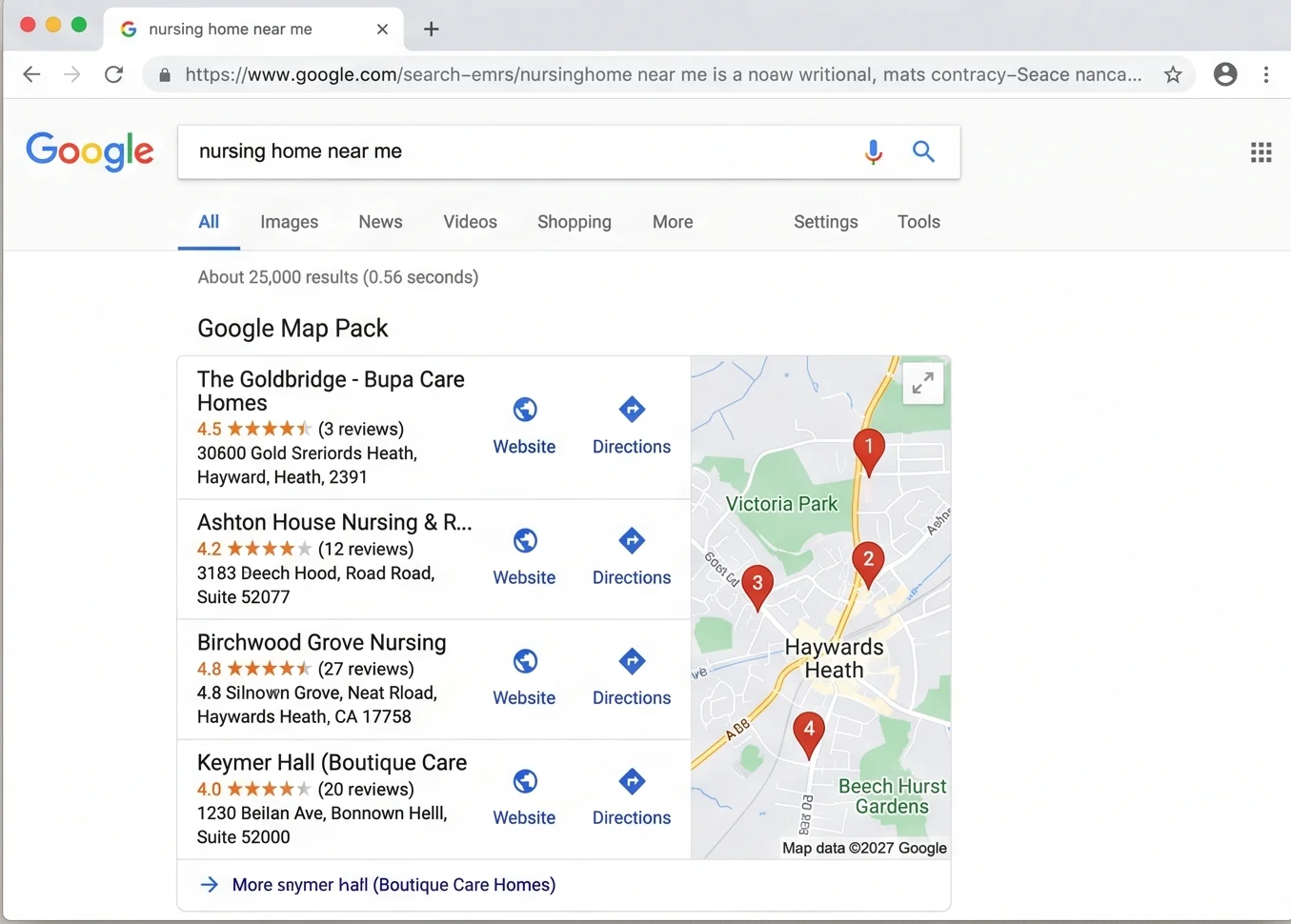
The map pack is the three homes pinned at the top, with the map beside them. This is proximity's territory. If you're not physically close to the searcher, you're not getting in, no matter how good your reviews are or how many pages you've written. The map pack is a postcode lottery, and it's weighted heavily towards whoever is nearest.
The organic results below the map barely use proximity at all. These are the sponsored links, the ten standard results that appear under the map. They're won on relevance and prominence. A home badly placed geographically isn't beaten, it's just fighting on the wrong ground.
Knowing which one you're losing tells you which lever to pull. If you're not in the map pack for searches in your immediate area, the problem is likely your Google Business Profile. Wrong categories, missing services, no reviews. If you're not in the organic results for searches across your wider catchment, the problem is your website. Not enough pages, not enough detail, not enough evidence of what you do.
Directories dominate the organic results for "care homes near me" and "nursing homes near me". That's not a conspiracy. It's because directories have built thousands of pages, each one answering a specific search in a specific place. They've given Google an enormous amount of evidence to work with. You can do the same on a smaller scale, for your home and your catchment. A page for every care type, in every town you draw from.
What This Means for Your Home: Three Things to Do This Week
First, audit your Google Business Profile. Is nursing care in your categories? Are your services listed properly? Is your description written for families making an impossible decision, or does it read like it was copied from a CQC submission? Fix the basics. It takes an hour.
Second, write a page for every care type you offer. Not a paragraph. A page. If you offer respite care, there should be a page titled "Respite care in your town" that answers the questions families actually ask. What does it cost? How long can someone stay? What happens next? If a family can't find the answer on your site, they'll find it on a directory instead.
Third, build a review habit. Ask families at the right moment, when someone has just said something kind about your team. Make it easy. Send them the link. A home doing brilliant care has nothing to fear from asking, and everything to gain from being visible.
Alternatively, if you don't have the time to do the above, we can help; this is what we specialise in. Book a call with us, and we can discuss how we can do this for you.
The Bottom Line
Google isn't judging your care. It's judging how well you've documented it.
Proximity you can't change. Relevance and prominence you can. And the families searching from 60 miles away never see proximity at all. They're making their shortlist from organic results, where the evidence you publish is the only thing that counts.
The homes winning private enquiries aren't spending more on marketing. They're answering the questions families actually ask, and making the evidence easy to find. That's the whole game. It's very learnable, and it starts with giving Google something to work with.
This might sound like a huge amount of work, but this is something at TRG Digital we do every day for our clients, and we generate hundreds of online enquiries each month.
Book a call with us, and we can explain how we can do the same for you.