How do care home discharge teams find and refer to homes like yours?

Written by Len Burgess, Founder
Len Burgess is the founder of TRG Digital, a specialist digital agency for the UK care sector. He has worked in SEO and digital marketing for over a decade and writes about search, ranking factors and lead generation through a data-first lens: read the data, apply best practice and logic, test, and repeat until you rank.
Connect on LinkedIn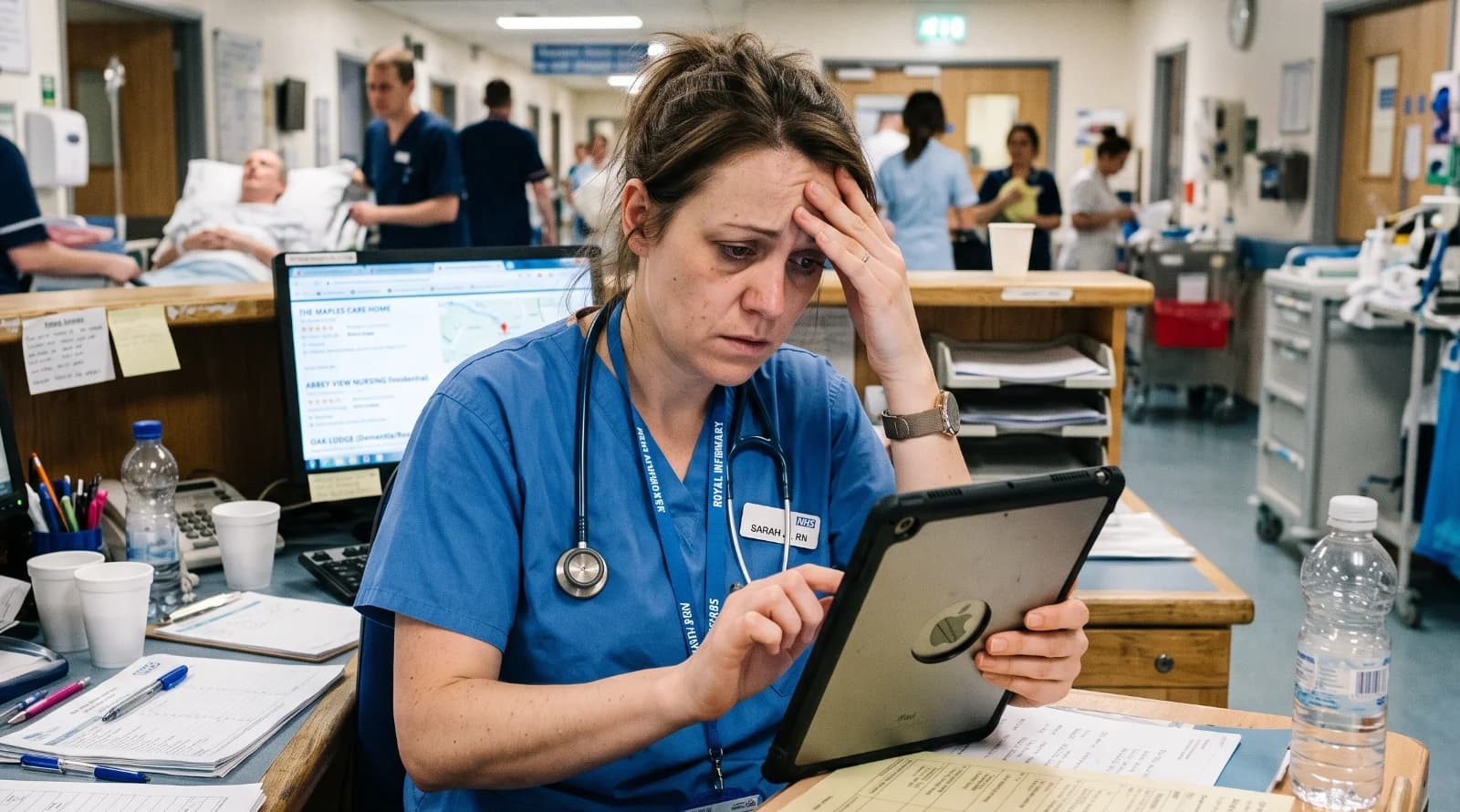
Hospital discharge teams, social workers and NHS assessors search online for care homes under intense time pressure, and most care home websites fail them because they are written only for families.
Being findable and credible to these professionals is a separate lead channel from private family enquiries, and one that most homes ignore. A dedicated referrers page with operational facts can change that.
What do discharge coordinators actually need from a care home website?
Discharge coordinators need operational facts in seconds, not minutes. They are assessing multiple homes against clinical needs and placement timelines, not browsing emotionally like a family member.
A coordinator working a hospital ward at 4pm on a Friday is not reading your welcome message or your philosophy of care. They are scanning for registration type, nursing capability, dementia care provision, fee acceptance and current bed availability. If any of those facts are missing, the home is filtered out before a phone call happens.
According to Careassura.com, the professionals involved in discharge include discharge coordinators, acute discharge case managers, social workers, occupational therapists and mental health practitioners.
Each of these people may search for homes at different points in the process, and each has a different clinical question to answer. A social worker may be checking whether a home accepts local authority fee rates. A discharge coordinator may be checking whether a nursing home can manage insulin administration or wound care.
The tone of a typical family-focused homepage does not answer those questions. Phrases like "a home from home" and "warm, caring environment" tell a coordinator nothing about whether the home can take a patient with complex nursing needs this week. That is not a criticism of family-focused copy. It is simply the wrong content for a different audience with a different job to do.
A dedicated referrers page or section signals that the home understands the discharge process and is set up to work with professionals. Manor House Care Home in Stafford publishes a referrers page that leads with the practical details professionals need, which builds immediate confidence that the home is organised and responsive.
How does the hospital discharge process work in the UK?
The discharge to assess model uses four pathways, from pathway 0 to pathway 3. According to GOV.UK, pathway 0 covers patients discharged home with no new needs, pathway 1 covers home with new needs, pathway 2 covers a community bed-based setting with recovery support, and pathway 3 covers a new residential or nursing home placement for likely long-term care. Pathway 3 is the one that matters most for care homes, and it is used only in exceptional circumstances.
Discharge can only happen with the patient's consent and that an arrangement to discharge a patient to a care home can only be made with their consent, and the default destination is their own home unless they choose a care home placement. This means referrals are not automatic. Homes are part of a choice process, and the patient or their family may be comparing several options.
The guidance was updated in January 2024 to strengthen the duty to co-operate between health and social care bodies. GOV.UK notes that the update added detail on the duty to co-operate, involving families and carers, and care transfer hubs. Partnership working with local discharge teams has become more important than ever as a result.
Work with TRG
Struggling to fill your beds?
See how we turn local searches into pre-qualified enquiries, delivered straight to your home.
What does a discharge team need to see in under 30 seconds?
A discharge team needs bed availability, nursing capability and fee acceptance visible in under 30 seconds. Bed availability is the single most useful piece of information. A discharge coordinator will not call a home that shows no vacancies, and they rarely have time to call every home in the catchment to ask. If a home has a live availability signal on its website, it moves to the top of the shortlist.
Nursing-need specifics filter homes in or out instantly. If a patient needs insulin management, wound care or end of life support, the home must state clearly whether it can provide that. Nottingham CityCare describes general nursing interventions such as wound care, insulin administration and end of life care that are provided to residents within residential care homes, but not nursing homes. A coordinator reading a vague website cannot tell whether the home can meet those needs, and ambiguity means elimination.
Fee acceptance matters. Discharge teams handle patients funded by local authorities and the NHS, so a home that only courts private payers will be crossed off the list for those referrals. A home that states clearly which funding types it accepts saves the coordinator a phone call and positions itself as a realistic option.
A phone number and a named contact for referrals, plus response times, tells a coordinator that the home is organised and used to working with professionals. Manor House Care Home in Stafford includes a direct referral contact and a clear process on its referrers page, which is exactly what a time-pressed professional needs.
Why do most care home websites fail the professional referral test?
Most care home websites fail the professional referral test because they are built to answer family questions about fees, lifestyle and visiting.
Those are the wrong questions for a discharge coordinator under pressure to place a patient this week. A coordinator does not need to know about activities, menus or visiting hours. They need to know whether the home can take a patient with specific clinical needs, at a specific funding level, within a specific timeframe.
Generic agency-built sites rarely include a referrers page. If they do, it is often a single paragraph of contact details rather than a practical tool for a professional. A paragraph that says "we welcome referrals from healthcare professionals" tells a coordinator nothing about registration type, nursing capability, fee acceptance or bed availability. It is a greeting, not an answer.
Homes that rely on word of mouth with local discharge teams assume relationships will survive staff changes. When a coordinator moves on, the new person starts from a blank page. The website is their first stop, and if it does not answer their questions, the home is not on their list.
The cost of failing this test is concrete. A bed stays empty while a coordinator places a patient in a competing home that answered the questions clearly. Manor House Care Home in Stafford demonstrates what a referrers page should do by leading with the facts professionals need, and homes without that page are at a measurable disadvantage.
How can your home build a page that discharge teams will actually use?
A referrers page should lead with the facts a coordinator needs: registration type, nursing and dementia capabilities, fee acceptance across local authority and NHS funded placements, and current availability. The page should be structured so that a professional can scan it in under 30 seconds and know whether the home is a viable option. Every field that requires a phone call to clarify is a reason to move to the next home.
Practical tools make the difference between a static page and a useful one. TRG Digital builds live availability widgets and funding checkers that show discharge teams real-time information without a phone call, which is what a time-pressed coordinator actually needs. A live room availability widget answers the first question a coordinator has before they pick up the phone. A funding checker answers the second.
Include the practical details of the referral process: who to contact, their direct line, and what information the home needs from the hospital to assess a referral quickly. The Locala Care Home Support Team triages referrals within two working days and operates set hours, which means a home's response time matters in a coordinated effort. A referrers page that states a response time shows the home understands that rhythm.
Show that the home understands the discharge pathway by referencing the discharge to assess model and pathway 3 placements. This signals competence to the professionals reading it.
According to GOV.UK, pathway 3 covers new residential or nursing home placements for likely long-term care, and a home that speaks that language is immediately more credible.
What does a good referral relationship look like in practice?
A good referral relationship starts with a clear process for triaging referrals, including knowing which patients the home can and cannot support clinically. A care home that accepts hospital discharge referrals needs to be honest about its clinical limits. Accepting a patient whose needs exceed the home's capability creates risk for the resident, the staff and the home's reputation with the local discharge team.
Work with TRG
Want more private enquiries?
We put your home in front of the families actively searching for care near you.
Some NHS teams operate structured triage processes. The Locala Care Home Support Team aims to triage all referrals within two working days and operates 8:00am to 5:00pm Monday to Friday, excluding Bank Holidays. A home that responds within the same window becomes a reliable partner in that coordinated effort.
Homes should know the local NHS and social care structures in their area, from care transfer hubs to integrated care home teams. Nottingham CityCare describes an Integrated Care Homes Service that supports the health needs of the care home population and works in partnership with GPs to identify patients at risk of hospital admission or readmission. Portsmouth's Community Care Home Team is another example of a local structure through which referrals arrive.
A home that builds a reputation for responding quickly and honestly to referral enquiries becomes a trusted option that coordinators call first when a difficult placement arises. Wakefield District Health and Care Partnership describes a partnership approach to discharge that depends on local providers being responsive and reliable. That reputation is built one referral at a time.
What information should you prepare before a discharge referral arrives?
A referral pack for professionals should include the home's CQC rating, its registration details, fee structure for funded placements, and a clear statement of the care needs it can meet. Having this pack ready means the home can respond to a referral enquiry within minutes rather than hours. The pack should be available as a downloadable document and summarised on the referrers page.
The home should be ready to answer questions about specific clinical needs, from dementia outreach support to general nursing interventions. Nottingham CityCare describes a Dementia Outreach Team that provides specialist dementia mental health support to residents with severe dementia presenting as challenging and complex behaviour, and a General Nursing team that provides interventions such as wound care and insulin administration. A home that knows which of these services it can access, and which it cannot, can answer referral questions accurately.
Knowing the local referral routes matters. Different areas use different systems, from online portals to phone lines. The Locala Care Home Support Team accepts referrals for permanent residents of older persons care homes and hospital discharge for permanent residents only, with temporary residents referred to GP practices. A home that understands these routes can respond faster and avoid wasting time on referrals that are not appropriate.
Being explicit about what the home does not accept is as useful as stating what it does. It saves the coordinator time and protects the home from unsuitable referrals. Manor House Care Home in Stafford demonstrates this by publishing clear referral criteria, which means professionals only contact the home when there is a genuine fit.
Conclusion: Build the Page Your Referrers Are Already Looking For
Part of our guide to filling empty beds.