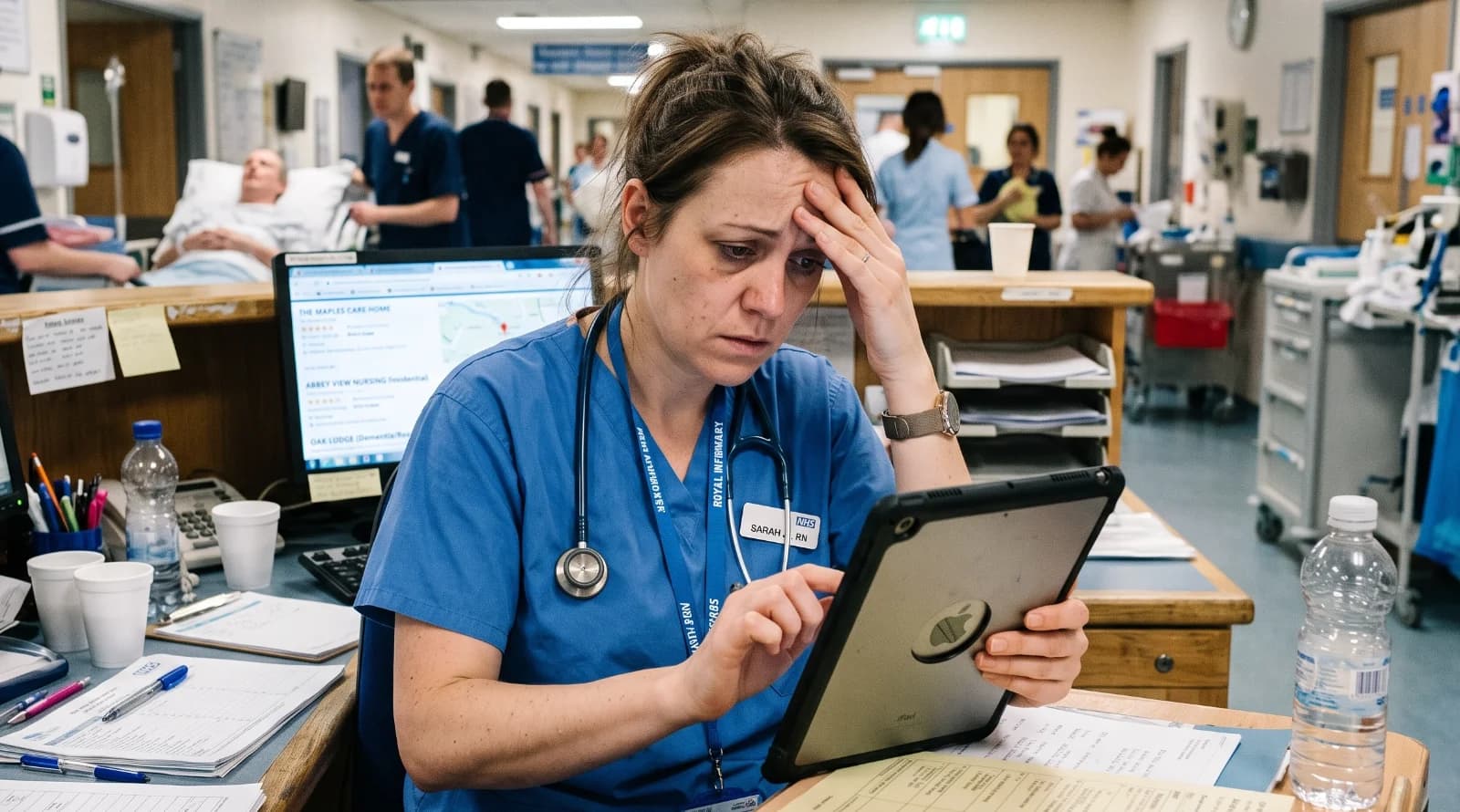
How do discharge teams find care homes for patients?

Written by Len Burgess, Founder
Len Burgess is the founder of TRG Digital, a specialist digital agency for the UK care sector. He has worked in SEO and digital marketing for over a decade and writes about search, ranking factors and lead generation through a data-first lens: read the data, apply best practice and logic, test, and repeat until you rank.
Connect on LinkedIn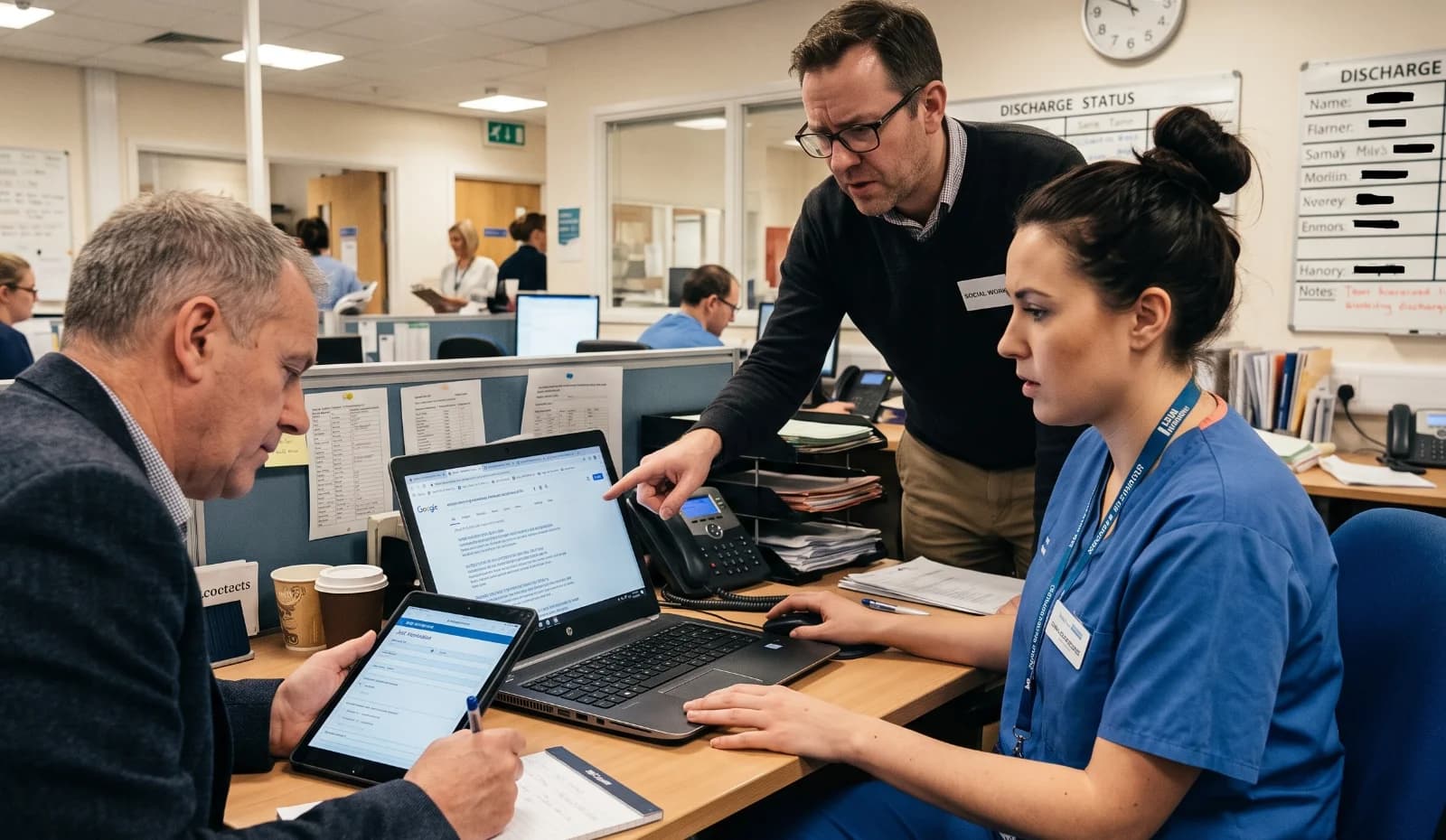
Discharge coordinators, social workers and CHC assessors find care homes through Google searches made under severe time pressure, using clinical and funding criteria that family-facing websites rarely answer.
They shortlist from what they can see on screen in about 30 seconds. Most care home websites are written only for families, so they answer none of the questions a professional needs answered.
Fixing this is a website and content job, not a sales job.
Who actually searches for a care home place during a hospital discharge?
The people searching are discharge coordinators, social workers, hospital clinical teams and CHC assessors, not families alone. Under the discharge-to-assess model set out in the Hospital discharge and community support guidance, there are four pathways.
- Pathway 0 is discharge home with no new care needs.
- Pathway 1 is discharge home with new or additional care needs.
- Pathway 2 is discharge to a community bed-based setting for short-term recovery.
- Pathway 3 is discharge straight to a residential or nursing home, and the guidance states it should only be used in exceptional circumstances.
Complex discharges are referred to multi-agency integrated discharge teams. According to Bradford Teaching Hospitals, a discharge is complex when an existing home care package changes, there is a safeguarding issue, intensive community nursing input is needed, or more than one agency is involved. Around 20 per cent of discharges fall into this category.
Referrals come directly from hospital clinical teams and social workers working inside the hospital. The Local Community Discharge Team confirms that referrals come from hospital clinical teams and social workers, not from families making their own arrangements.
The January 2024 update to the discharge guidance added detail on the duty to co-operate and the duty to involve unpaid carers and family members.
This audience searches differently from families. Criteria comes first, availability second, location third. A discharge coordinator knows exactly what clinical support the patient needs before they open a browser.
What does a discharge coordinator need to see in the first 30 seconds?
A discharge coordinator needs a dedicated "for professionals" page that states catchment, bed types, nursing and dementia capability, and who to ring, all visible without scrolling or clicking.
The page must answer four questions immediately: can you take this patient, do you have a bed now, what clinical needs can you support, and who do I call?
Same-day and short-notice availability signals matter more than anything else on the page. A live room availability feed changes the conversation entirely, because the coordinator can see what is free without ringing round. The Local Community Discharge Team operates 8am to 8pm, seven days a week, which tells you the hours professionals work.
The referral route must be obvious. A phone number, email, referral form and named contact all need to sit above the fold. A general enquiries inbox is not a referral route. The Bradford Teaching Hospitals page lists a direct phone number for appointment queries, and that is the standard professionals expect.
The page should confirm which funding routes the home works with, including CHC and fast-track funding. It must not imply any influence over assessment outcomes. The assessment is a separate process, and a home that appears to blur that line loses trust.
Work with TRG
Struggling to fill your beds?
See how we turn local searches into pre-qualified enquiries, delivered straight to your home.
A brochure homepage fails here. The professional has no time to hunt for a phone number behind three clicks, and they will not read a welcome message about your philosophy of care. They will leave and ring the next home on the list.
Which nursing and clinical details filter you in or out?
The clinical details that filter you in or out are specific nursing capabilities, not general statements. A discharge coordinator needs to know about registered nursing cover, PEG feeding, syringe drivers, dementia and challenging behaviour support, and end-of-life care. Each of these is a yes or no question. If the answer is not on the page, the home is filtered out.
Under pathway 3, a short-term care home placement cannot be arranged without the involvement of the Home First Hospital Discharge Team. The South Tyneside Adults chapter states that the team must complete a C2 and, if appropriate, a Mental Capacity Act assessment prior to discharge. A home that understands these requirements and can confirm it has the documentation in place is easier to work with.
Intermediate care and reablement are free for up to six weeks, according to the NHS page on planning to leave hospital. A home should state what it can offer during that free period and what happens after it ends, including the chargeable rates that apply.
Fast-track discharges apply to patients with limited life. The Bradford Teaching Hospitals page states these patients are discharged home with fast-track funding, usually on the same day of referral. A home must be ready to confirm instantly whether it can accept a fast-track patient and what it needs to process the referral.
Vague phrases like "complex needs considered" cost referrals. They tell a coordinator nothing. The phrase reads as a maybe, and a coordinator under time pressure does not have time for a maybe.
How do professionals find you when they have never heard of your care home?
Professionals find care homes through Google searches built around clinical criteria and availability, not brand names. The searches look like "nursing homes with availability in Chelmsford", "dementia care home Essex", or "care home near Broomfield Hospital". They are specific, urgent, and often made from a hospital ward.
Local SEO and a managed Google Business Profile are the shop window for out-of-area professionals. A discharge coordinator in a hospital 20 miles away will not know your home exists unless you show up for the searches they make. The Hospital discharge and community support guidance makes clear that discharge teams work across local authority boundaries, so catchment-based search visibility matters.
Location and service pages should match how discharge teams search. A page titled "Nursing care near [hospital name]" or "Dementia care homes in [town]" answers the query directly. Hospital-adjacent phrasing matters because the searcher is thinking in terms of travel time from a specific hospital, not a vague region.
A listing alone will not fill beds. A directory entry tells a coordinator you exist, but it does not answer the clinical questions or show availability. What sits behind the listing is the website page that converts a search into a referral.
What should a "for professionals" page actually contain?
A "for professionals" page should contain everything a discharge coordinator needs to make a referral decision without making a phone call. TRG Digital builds these pages as part of care home websites designed around how care is actually chosen: fast, mobile-first and structured to convert a visit into an enquiry.
The page checklist starts with bed types and availability. A coordinator needs to know whether you offer residential, nursing or dementia care, and whether you have a bed free today. Clinical capabilities come next, stated as specific yes or no answers rather than general descriptions.
Catchment and travel time from local hospitals should be explicit. A coordinator searching for a bed near a specific hospital needs to know how far away you are. The Local Community Discharge Team bases its Discharge to Assess beds in care homes in Kirklees, which shows how location is tied to specific hospital sites.
The referral route, funding routes accepted, named contact and out-of-hours number all need to sit on the page. Live room availability removes the phone call that currently stands between a coordinator and your home. A coordinator can see what is free without ringing round.
Custom tools do real work on these pages. A funding calculator or NHS funding checker answers the funding question before it becomes a blocker. TRG Digital builds these as part of care tools that make a provider's website genuinely useful. Every page ends with one clear next step: a referral form, a phone number or a booked call.
Work with TRG
Want more private enquiries?
We put your home in front of the families actively searching for care near you.
How do you keep availability accurate when beds change daily?
The person who owns the update is the registered manager or a named deputy, and the update must happen daily, not weekly. A weekly PDF is worse than no PDF at all, because it looks current while being wrong. A coordinator who sees a bed listed as available that went three days ago will not trust the home again.
Simple mechanisms work best. A live availability widget that the manager updates from a phone takes 30 seconds. A daily one-line update on the professionals page does the same job. A direct line that is actually answered, with a named person at the other end, is the minimum.
What happens to trust when a coordinator rings about a bed that went three days ago is simple: the trust is gone. The coordinator has a list of homes to call and a patient waiting. They will not call you first next time. The Bradford Teaching Hospitals page shows how discharge teams operate at speed, and speed punishes inaccurate information.
The page below is a live page we built for one of our clients. The page is listed in the top navigation; it has the room availability widget present and showing 1 room available, and all the contact details available.
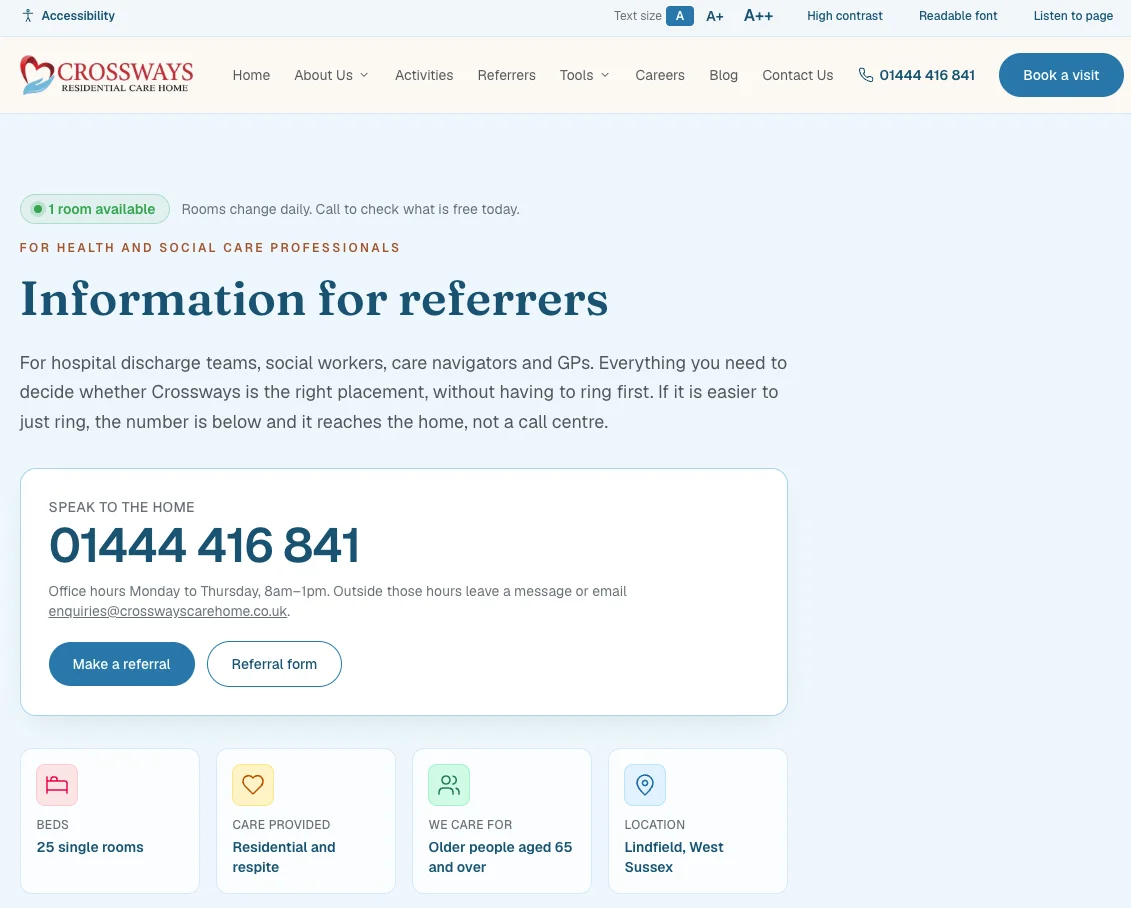
Accuracy matters more to this audience than polish. A plain page with correct availability beats a beautiful page with outdated information every time. The professional is not judging your design. They are judging whether they can rely on what you say.
How do you measure whether professionals are actually finding you?
You measure it by tracking referral source properly. Every professional caller should be asked how they found you, and the answer should be logged. A simple spreadsheet with columns for date, source, enquiry type and outcome is enough to show patterns.
The signals that matter are professional enquiries, referral forms submitted and calls from hospital numbers. These are the outcomes that lead to beds filled. The Hospital discharge and community support guidance describes a system built around pathways and referrals, and your measurement should mirror that language.
Judge the website on enquiries and tours, not traffic. A page that gets 50 visits a month but produces no professional enquiries is failing, whatever the traffic number says. Review quarterly against occupancy and fee mix, not against rankings. The question is whether the right residents are filling beds at the right fee level.
What changes for mental health, homeless and out-of-area discharges?
Mental health discharges are covered by separate guidance, so the pathway and the referral route differ. The Hospital discharge and community support guidance states that discharges from mental health hospitals are excluded from the main guidance. A home should not assume the standard pathway applies.
Patients with no fixed residence need a different conversation before a bed can be offered. The funding and assessment route is not the same as for a patient returning to an existing address. A home should ask the referring team to clarify the funding position before accepting the referral.
Out-of-area placements require the receiving home to confirm funding and assessment arrangements with the placing authority. The duty to co-operate in the January 2024 guidance update is relevant here, because it requires NHS bodies and local authorities to work together across boundaries.
Local pathway numbering can differ between trusts. The South Tyneside Adults chapter uses pathway numbers that may not match another trust's numbering. Ask which pathway the patient is on, and what it means in that trust, rather than assuming.
Conclusion
Discharge coordinators, social workers and CHC assessors will not wait for a care home website to explain itself. They need to see bed types, clinical capability, availability, funding routes and a named contact within seconds, or they move on to the next home on the list. Most care home websites are not built for this audience, and that is where TRG Digital can help.
We build care home websites around how placements are actually decided: a dedicated "for professionals" page with the key information above the fold, a live availability feed your manager can update from a phone in 30 seconds, and location and service pages written for the hospital-adjacent searches discharge teams make.
We add local SEO and Google Business Profile management so out-of-area professionals can find you, and custom tools such as funding calculators and NHS funding checkers that remove blockers before the first call. Everything is set up to be measured in professional enquiries, referrals and beds filled, not traffic.
If your website is only speaking to families, talk to TRG Digital about making it work for the professionals who fill your beds.