Are paid care directories worth it for UK care homes?

Written by Len Burgess, Founder
Len Burgess is the founder of TRG Digital, a specialist digital agency for the UK care sector. He has worked in SEO and digital marketing for over a decade and writes about search, ranking factors and lead generation through a data-first lens: read the data, apply best practice and logic, test, and repeat until you rank.
Connect on LinkedIn
Sometimes, but only for specific jobs. Paid care directories can earn their place through reviews, awareness and urgent placements, but they should not be the main source of private enquiries. The model a directory uses matters more than the brand: a subscription listing, a fee per enquiry and a commission per placement all behave very differently when your home is full or empty.
The same families can also be reached directly through your own website and Google Business Profile.
Keep reading and get all the details.
How do the main UK care directories actually charge?
Care directories in the UK generally charge in one of three ways. The first is a subscription listing, where you pay a flat monthly or annual fee for a profile. That fee is payable whether or not a single family makes contact, which makes it predictable but not performance-based.
The second model is a fee per enquiry or lead. You pay when a family contacts you through the platform, regardless of whether they tour the home or move in. This can produce a steady flow of contact, but you are paying for conversations, not admissions.
The third model is commission per placement. The directory takes a percentage or fixed sum once a resident moves in. That looks cheap on the first invoice because you only pay when a bed is filled, but the total cost grows with the length of stay and the fee level.
Public sector directories work differently. The CQC care services search and many local authority listings are free to appear in, and they are not commercial platforms. The Derbyshire care services directory is compiled in association with Care Choices and can be viewed online or ordered as a paper copy. The CQC care services page covers care homes, homecare agencies and other regulated services, and it is free to use.
Any fee figure should be checked against a dated source. Prices change, and a figure quoted without a date is not a reliable basis for a budget decision. Treat any directory pricing you are given as a starting point for negotiation, not a fixed market rate.
What does commission per placement really cost over a long stay?
Commission per placement scales with length of stay and fee level, which means it penalises exactly the residents you most want. A worked example makes the maths clear.
Take a self-funding resident paying a typical private fee of £1,200 per week. Over a three-year stay, that resident is worth roughly £187,000 to the home. If a directory charges a commission of one week's fee per placement, the invoice is £1,200. That feels reasonable on the day the resident moves in. But if the commission is structured as a percentage of the first year's fees, say 10 percent, the cost is £6,240. Some models charge a fixed sum per placement that can run into several thousand pounds.
Work with TRG
Struggling to fill your beds?
See how we turn local searches into pre-qualified enquiries, delivered straight to your home.
Compare that against the same resident arriving through your own website. The cost is a one-off marketing spend: the website build, the local SEO work, the content that answers the family's questions. That spend does not increase if the resident stays for five years instead of three. The directory commission, by contrast, grows with every additional week of occupancy.
Commission models can still suit urgent, short-notice placements where a home would otherwise sit empty. If a bed is vacant and a family needs to place someone within days, paying a placement fee to fill that bed quickly is often the right commercial call. The problem comes when commission becomes the default route for private residents who could have found you directly.
Who owns the family relationship and the enquiry data?
On most paid directories, the family relationship sits with the platform, not with your home. That is the single most important question to ask before signing up, and it is rarely printed on the sales deck.
Ask what contact details you actually receive when a family enquires. Ask whether you can contact that family again after the first conversation. Ask what happens to the enquiry history and the family's data if you stop paying the directory. The answers tell you who really owns the relationship.
This matters for repeat business, referrals and reviews. A family that places a parent with you may later need respite care, or may recommend you to a friend, or may leave a review that brings in another enquiry. If the directory holds the relationship, those follow-on opportunities are harder to reach. The directory may also market other services to that family, or route future enquiries to whichever home is paying at the time.
Enquiries that land on your own site are different. The family, the data and the follow-up are yours. You can call them back, email them, invite them to an open day, and build the relationship over time. The NHS national homecare providers page works the same way: it lists organisations, but it does not hand you the family.
Will families see your competitors alongside your home?
Yes, on most directory listings your profile sits next to other homes in the same area and price bracket. That is the nature of a directory: it exists to help families compare options, and your home is one option among several.
That is not automatically bad. When a family is still researching, seeing your home alongside others can help them understand what you offer and how you compare. A clear profile with strong reviews and a good CQC rating can stand out in that context. The comparison stage is where directories do genuine work for awareness and credibility.
It works against you when the family is ready to enquire, and the platform lets them contact three homes at once. At that point you are no longer being compared on quality; you are being treated as one of several leads the family has thrown out. The family may tour all three homes, or they may simply take the first call back.
Google Business Profile and your own website put your home in front of the family without a row of alternatives. The family searches, finds you, and contacts you directly. According to Well Aware, the CQC directory is one of several places families can compare services, but a direct search for your home's name or your town plus care type leads to you, not to a list of competitors.
Where do care directories genuinely earn their place in your budget?
Directories do real work for reviews and third-party credibility, especially for families who have never heard of your home. A family that finds you through a directory may not know your reputation, but they can see your CQC rating, read reviews, and check your profile against others. That independent context can be the difference between an enquiry and a pass.
Work with TRG
Want more private enquiries?
We put your home in front of the families actively searching for care near you.
Directories also help with awareness in a catchment you do not yet cover well. If you are trying to reach families in a neighbouring town where you have no word-of-mouth presence, a directory listing can put your name in front of people who would not otherwise find you.
Urgent placements are another genuine use. When a bed needs filling quickly, and a family is short on time, a directory can connect you fast. The fee is the price of speed, and it is often worth paying.
Local authority and NHS routes are where free public listings do real work. The CQC care services search lets families find and compare regulated services at no cost to the provider. Local authority directories, such as the Derbyshire care services directory, are compiled with partners like Care Choices and are free to appear in. The NHS national homecare providers page lists regulated homecare providers at no cost, though it only covers organisations offering services nationwide across England.
How can you reach the same families through your own site and Google profile?
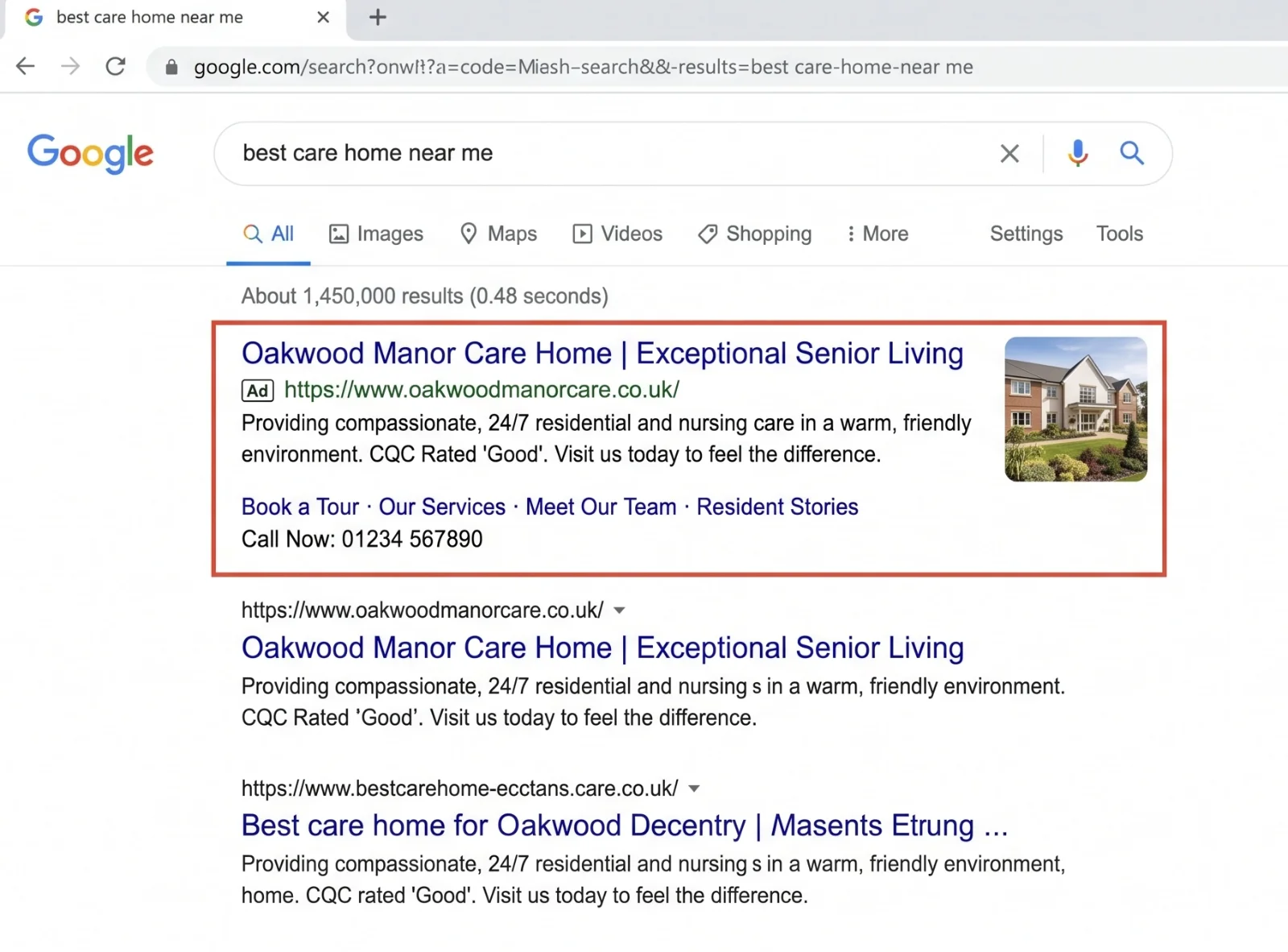
The same self-funding families who use directories also search Google directly, often late at night and often from a hospital ward. They type "care homes near me" or "dementia care in Chelmsford", open three or four websites, and form a shortlist in minutes. If your home shows up in the map pack and local results, you reach those families before they ever open a directory.
Local SEO is the mechanism. TRG Digital builds every local signal Google looks for: a fully optimised website, local pages for each area you serve, consistent listings, and a steady flow of genuine reviews. The result is a presence that puts you in front of local families and keeps you there, without a fee per enquiry or per placement.
A fast, mobile-first website is the second piece. Website development from TRG Digital structures pages around real search behaviour for local care searches, writes content that speaks to CQC ratings, funding routes and care types, and designs enquiry journeys that turn quiet visits into booked tours. When a family lands on your site at 9pm from a hospital ward, the site has to answer their questions and make the next step obvious.
SEO compounds. Rankings keep producing enquiries without a cost per click, unlike paid placements that stop when you stop paying. For faster fill when beds are empty, enquiry generation campaigns measured on qualified enquiries can run alongside organic work, switched on when you have empty beds and paused when you are full.
Conclusion
Care directories are not good or bad in themselves. They are a tool that suits some jobs better than others. Keep them for what they do well: third-party reviews, awareness in towns where nobody knows your name yet, and filling a bed quickly when it would otherwise sit empty. Every private resident who could have found you directly but came through a directory costs you a fee, a share of the relationship, or both.
TRG Digital helps care homes win those residents directly. We build fast, mobile-first websites that answer families' questions about fees, funding, and CQC ratings. We also do local SEO that gets your home into the map pack when families search in your area. When you have beds to fill quickly, our Enquiry Generation campaigns run alongside the organic work and pause when you are full. The enquiries come to you, not to a platform, so the family relationship and the data stay with your home.